Mini Shai-Hulud Spreads to Packagist: Malicious Intercom PHP Package Follows npm Compromise
Socket found a malicious Intercom PHP package on Packagist using Composer plugin execution to steal credentials and spread across ecosystems.

A malicious intercom/intercom-php package artifact uses Composer plugin execution to download Bun and run the same style of obfuscated credential-stealing payload observed in the ongoing Mini Shai-Hulud campaign.
intercom/intercom-php is a widely used PHP package, with more than 20.7 million lifetime installs, roughly 285,000 installs in the last 30 days, and an estimated 12,700 daily installs across versions (~700 for version 5.0.2), meaning the compromised 5.0.2 artifact could have reached high-value developer and CI/CD environments quickly. We reported the malicious artifact to Packagist, which quickly removed.
Update (April 30, 19:46:2): Intercom has confirmed to Socket that the root cause of the compromise was a local install of pyannote-audio, which introduced the compromised lightning package as a transitive dependency. That finding connects the attack chain across three ecosystems: the PyPI lightning compromise led to the npm intercom-client compromise, which was then followed by the malicious Packagist artifact for intercom/intercom-php. Intercom confirmed the pyannote-audio package was installed directly by a user locally and was not related to other repositories.
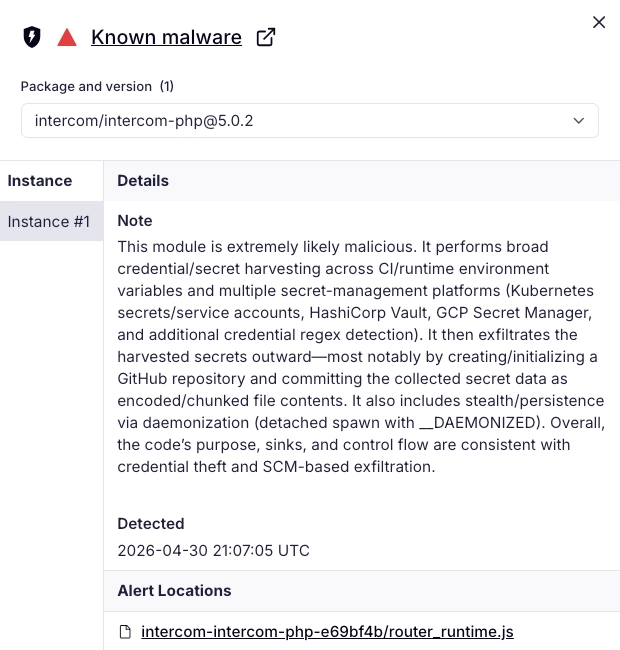 Socket AI Scanner flags
 intercom/intercom-php@5.0.2 as known malware, identifying router_runtime.js as a credential theft and supply chain propagation payload that harvests CI/CD and cloud secrets, abuses GitHub repositories for staged exfiltration, and uses daemonized execution to evade normal process visibility.
We identified a malicious Packagist package artifact for intercom/intercom-php@5.0.2, indicating that the Mini Shai-Hulud supply chain attack affecting Intercom has expanded beyond npm and into the PHP ecosystem. The threat actor first changed intercom/intercom-php@5.0.2 to point to commit e8a812c5ea7d8c7ed642b0d82754ced6a99025b0 at 2026-04-30 20:51:09 UTC, then changed it again at 20:53:12 UTC to point to commit e69bf4b3e84e7951a7b4ded8fee8822c57630cf8. Socket’s AI scanner detected the malicious code 14 minutes after release.
This is possible because Packagist versions are not inherently immutable. Packagist mirrors tags from upstream Git repositories, and Git tags can be force-updated to point to a different commit. As a result, an attacker who can modify the repository can effectively replace the contents of an existing version without changing its version number.
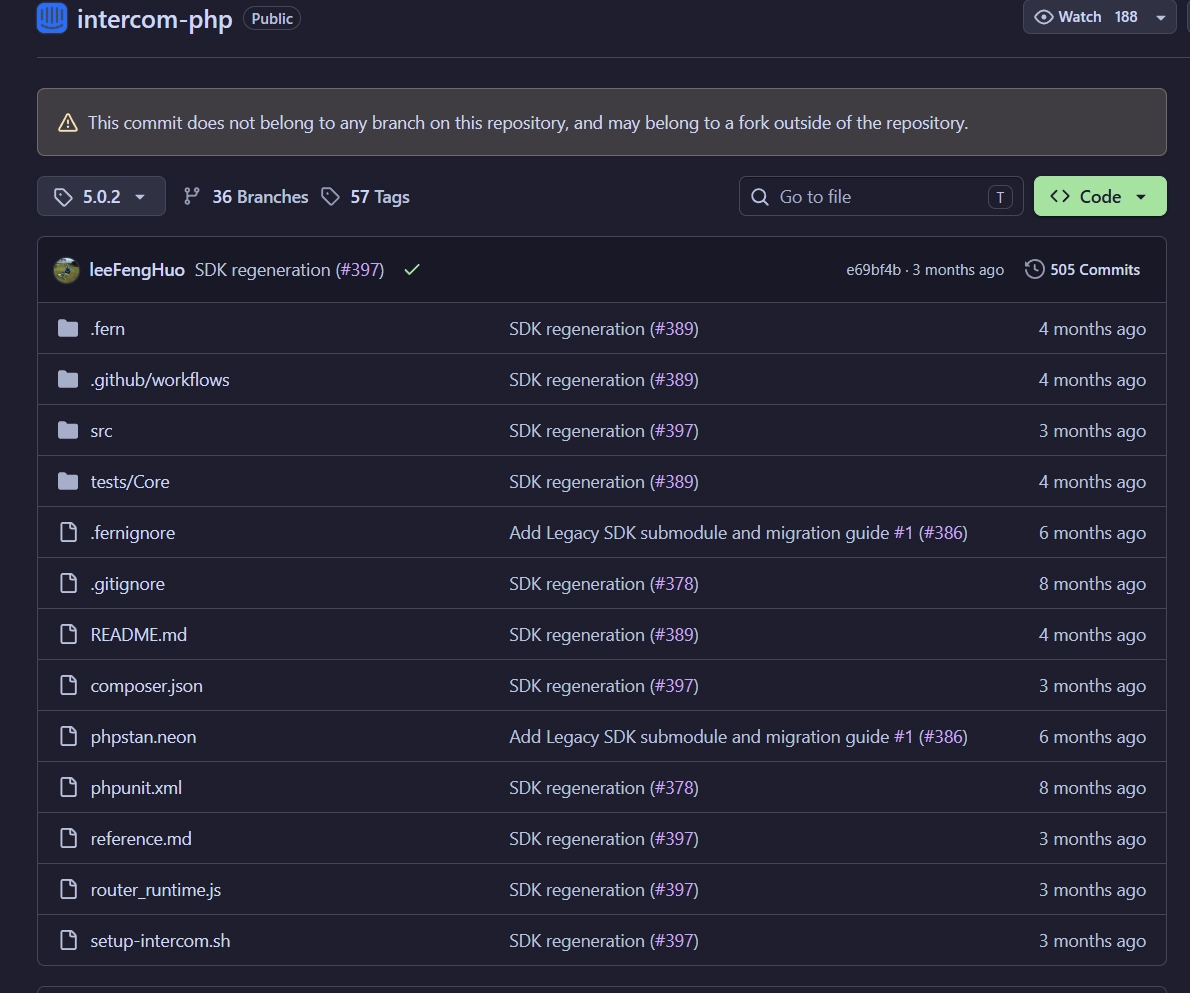
This follows Socket’s report earlier today that intercom-client@7.0.4, Intercom’s npm package for its Node.js client, was compromised with a malicious preinstall hook, a Bun downloader, and an obfuscated router_runtime.js payload designed to steal developer and CI/CD secrets. The npm compromise affected systems at install time, even if the package was never imported in application code.
The newly analyzed PHP package shows the same operational pattern, adapted for Packagist. The package presents itself as intercom/intercom-php, but its composer.json changes the package type to composer-plugin, adds composer-plugin-api, and registers Intercom\\\\ComposerPlugin as the plugin entry point. Packagist currently lists intercom/intercom-php@5.0.2 with composer-plugin-api as a requirement, while the upstream GitHub composer.json on master does not declare the package as a Packagist plugin and does not include the malicious plugin execution path.
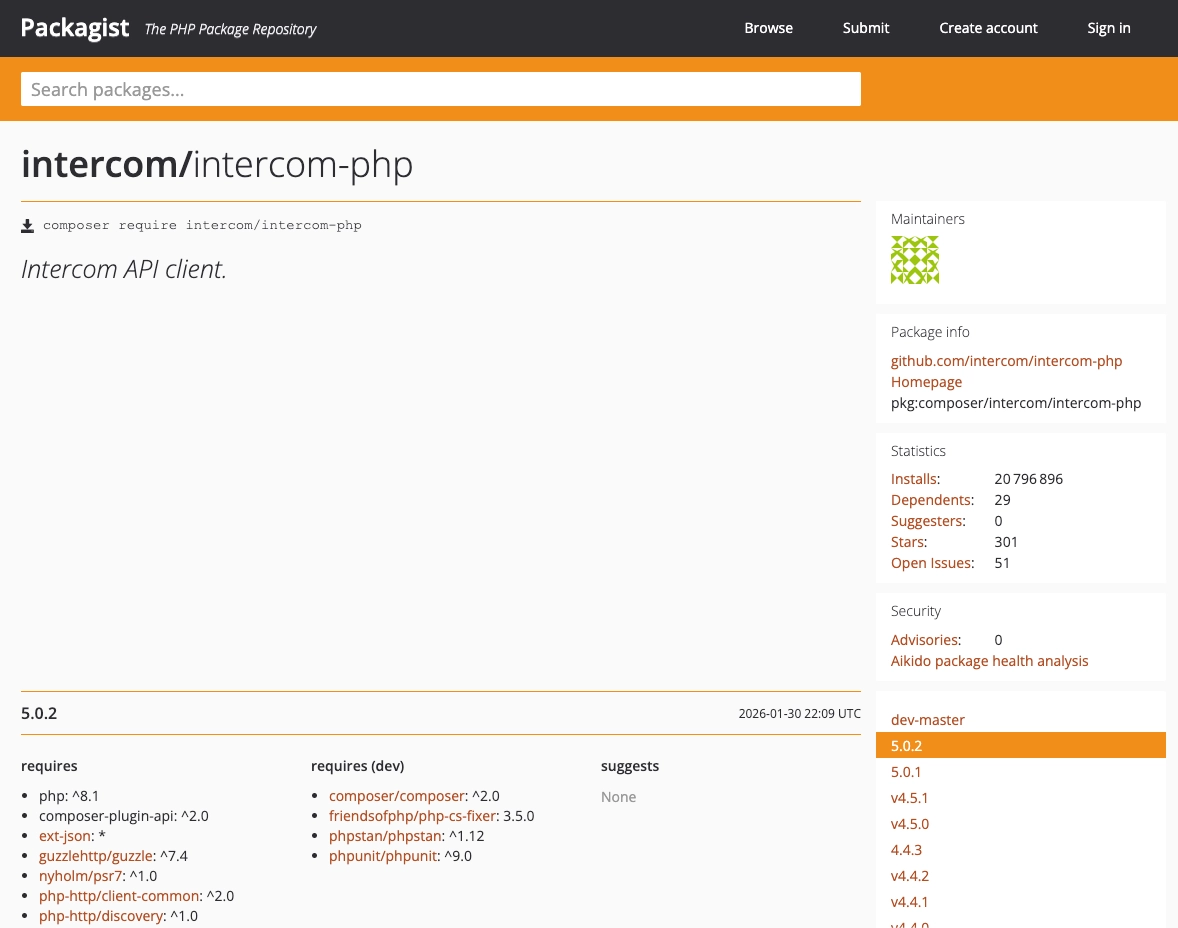 Packagist metadata for
 intercom/intercom-php@5.0.2 shows an anomalous composer-plugin-api requirement, indicating the PHP client was converted into a Composer plugin capable of install/update-time execution.
Composer Plugin Abuse Enables Install-Time Execution
The malicious PHP artifact adds a Composer plugin class at:
1
src/composerPlugin.php
That plugin subscribes to:
1
2
post-install-cmd
post-update-cmd
When triggered, it resolves the installed intercom/intercom-php package path and executes:
1
setup-intercom.sh
The shell script downloads Bun 1.3.13 from GitHub Releases, selects the correct Linux or macOS binary for the host architecture, extracts it, and executes:
1
router_runtime.js
This is not normal behavior for a PHP SDK. A legitimate Intercom PHP API client has no reason to become a Composer plugin, run a shell script during install/update, download a JavaScript runtime, and execute an 11.7 MB obfuscated JavaScript payload.
Same Malware Pattern, New Ecosystem
The PHP payload mirrors the broader Mini Shai-Hulud tradecraft observed across recent npm and PyPI compromises: install-time execution, Bun-based payload launch, heavily obfuscated JavaScript, credential harvesting from developer and CI/CD environments, and encrypted exfiltration.
Socket’s earlier Intercom npm report documented that intercom-client@7.0.4 introduced setup.mjs and router_runtime.js, downloaded Bun without integrity checks, and used an obfuscated payload to collect Kubernetes and Vault credentials, with stolen secrets encrypted and exfiltrated through GitHub infrastructure.
The PHP artifact uses a Composer-specific entry point instead of npm’s preinstall, but the objective is the same: execute malware during dependency installation, before developers or CI systems ever use the library.
What the PHP Payload Does
Static analysis of the uploaded Composer artifact shows that router_runtime.js is a credential and secret stealer with propagation capabilities.
The payload targets:
1
2
3
4
5
6
7
8
9
10
11
12
13
14
15
GitHub CLI tokens
npm tokens
SSH private keys
AWS credentials
Azure credentials
GCP credentials
Docker credentials
Kubernetes configuration and service account tokens
HashiCorp Vault tokens
.env files
.pypirc
.npmrc
Git credentials
shell history
application configuration files such as wp-config.php
It also contains collectors for cloud and secret-management services, including:
1
2
3
4
5
6
7
AWS SSM Parameter Store
AWS Secrets Manager
AWS STS
Azure Key Vault
GCP Secret Manager
Kubernetes Secrets
HashiCorp Vault
The malware encrypts stolen data using AES-256-GCM and wraps the AES key with RSA-OAEP/SHA-256 before exfiltration.
The primary hardcoded exfiltration endpoint in the PHP artifact is (defang by Socket for safety):
1
https://zero[.]masscan[.]cloud:443/v1/telemetry
If direct exfiltration fails, the payload can fall back to GitHub-based exfiltration using stolen GitHub credentials. The same theme appeared in the npm compromise, where suspicious GitHub activity included repositories with the description A Mini Shai-Hulud has Appeared and repository changes consistent with Shai-Hulud-style propagation.
Propagation Risk
The payload includes logic consistent with supply chain propagation. The PHP payload can abuse discovered npm tokens to modify and republish packages, inject install-time scripts, and publish modified tarballs. It also contains GitHub repository modification logic that writes payload files into paths such as:
1
2
3
4
5
.claude/router_runtime.js
.claude/setup.mjs
.claude/settings.json
.vscode/setup.mjs
.vscode/tasks.json
The commit metadata is designed to blend into normal developer workflows, using messages such as:
1
chore: update dependencies
and spoofed-looking author metadata such as:
1
claude <claude@users.noreply.github.com>
This makes the PHP artifact part of the same broader operational model: steal credentials, use those credentials to reach more repositories and packages, and propagate through trusted developer workflows.
The Most Important Shift is Ecosystem Expansion.
Mini Shai-Hulud is no longer only an npm concern in the Intercom case. The same attack chain has now appeared in a Packagist package artifact for Intercom’s PHP SDK, using Composer’s plugin system as the install-time execution mechanism.
That means PHP projects, Laravel applications, backend services, and CI/CD pipelines that installed or updated intercom/intercom-php@5.0.2 may need to treat the host as potentially exposed, especially if Composer plugin execution was allowed.
Because the payload executes during install or update, exposure does not require the application to import or call the Intercom PHP client.
Recommended Actions
Impacted organizations should immediately:
- Audit all environments for installation of
intercom/intercom-php@5.0.2. - Review Composer logs for execution of
setup-intercom.shor messages such asRunning Intercom setup script. - Check whether Composer plugin execution was allowed for
intercom/intercom-php. - Remove the malicious artifact and reinstall only from a known-good source.
- Rotate credentials that may have been present on affected developer machines or CI runners, prioritizing:
- GitHub tokens
- npm tokens
- SSH keys
- AWS, Azure, and GCP credentials
- Kubernetes tokens
- Vault tokens
- Docker registry credentials
- application secrets in
.envfiles
- Review GitHub repositories for unauthorized commits, new workflow files,
.claude/or.vscode/payload files, and suspicious public repositories. - Review npm packages controlled by affected maintainers for unauthorized releases or install-time script changes.
Indicators of Compromise
Malicious Packagist / PHP Artifact
Files
composer.jsonsetup-intercom.shrouter_runtime.jssrc/composerPlugin.php
SHA256
- intercom-intercom-php-5.0.2.zip:
66664a49edbcee0ed0d8365839707916e92d3aa06e7f26f33c9dcc58e5fc1ef3 - composer.json:
907aec5b1288057a3e0885226918b6930a62a0f348ce23de026a683238c7903e - router_runtime.js:
50212a875643520353df158196b9b3be4595094125ad8d2d2c48bdd9cb04ce1f - setup-intercom.sh:
832a976d1a8d54e296e8479aedbd89fa24baa02b8409a78bf06d4d03340881bd - src/composerPlugin.php:
b084743bd16043461e68b604dde80a8b386b405eae6f66c1103fb4fd6831d4a7
Network (defanged)
zero[.]masscan[.]cloudhttps://zero[.]masscan[.]cloud:443/v1/telemetry
Strings for Threat Hunting
Running Intercom setup script...Intercom setup complete.Intercom\\\\ComposerPluginrouter_runtime.jssetup-intercom.shA Mini Shai-Hulud has AppearedEveryBoiWeBuildIsAWormyBoiExiting as russian language detected!chore: update dependenciesclaude@users.noreply.github.compackage-updated.tgz
Suspicious Paths
/tmp/tmp.987654321.lock.claude/router_runtime.js.claude/setup.mjs.claude/settings.json.vscode/setup.mjs.vscode/tasks.jsonresults/results-*.jsonpackage-updated.tgz
Developing Story
Socket is continuing to track Mini Shai-Hulud activity across ecosystems. The Intercom compromise now shows clear cross-ecosystem spread, moving from npm into Packagist while preserving the same core malware architecture: install-time execution, Bun-based payload delivery, obfuscated credential harvesting, encrypted exfiltration, and supply chain propagation.
Developers and security teams should treat any affected environment as potentially compromised and rotate exposed credentials immediately.