Current Trends in the Turkish-Language Dark Web
An analysis of advertisements, posts, and interactions within Turkish-language hacking and cybercrime forums, exploring the capabilities, culture, and organization of these communities.
We analyzed advertisements, posts, and interactions within Turkish-language hacking and cybercrime forums to explore the capabilities, culture, and organization of these communities. This report is a follow-up to our previous reporting on the state of the Turkish-language dark web as part of a series analyzing cybercriminal communities in Brazil, Russia and China, Japan, and Iran. It will be of greatest interest to organizations and geopolitical analysts seeking to understand the cybercriminal underground in order to better monitor security-related threats, as well as to those researching the Turkish-language underground.
Executive Summary
Turkey’s increasingly unstable financial situation, with record inflation rates and a plummeting Turkish lira, has created conditions for disenfranchised young people to join underground communities and engage further in cybercriminal activities. We found that Turkish patriotic hacking collectives are continuing their defacement operations and at least 1 threat group is working to engage in more sophisticated hacking activities. Turkish-language cybercriminals are active on English- and Russian-language forums where they share and sell compromised data from Turkish entities. In our research, we identified at least 3 Turkish-language ransomware groups and we developed a YARA rule to detect TurkStatik Ransomware.
With the prevalence of ransomware-as-a-service (RaaS) models and the resulting decrease in barriers for entry to the ransomware space, we expect an increase in the number of Turkish-language ransomware groups. As a cornerstone of the Turkish underground community, we expect patriotic hacking collectives to continue their operations.
Key Judgments
- Turkish patriotic hackers continue their defacement operations targeting countries they perceive to be “enemies” of Turkey, and in some cases aim to ramp up the sophistication of their activities including leaking confidential data and building a hacktivist botnet.
- Turkish-language, financially motivated threat actors advertise their services, methods, and stolen data on popular global forums to avoid Turkish law enforcement attention and appeal to a larger audience.
- We identified at least 3 Turkish-language ransomware variants being used by threat groups including TurkStatik, SifreCikis, and DeadLocker. At the time of this report, we do not know the number of victims in Turkey affected by these ransomware variants as the operators of said ransomware do not operate extortion websites.
Background
As outlined in our previous reporting, Turkish-speaking dark web communities primarily focus on 2 functional areas: patriotic hacking (hacktivism) and financially motivated cybercrime. Patriotic hacking communities frequently respond to geopolitical events around the world, especially those relating to Turkey, and show support for the government agenda by targeting countries perceived to be “enemies” of Turkey. Financially motivated communities focus on a variety of fraud-related activities such as payment card fraud, data breaches, and social engineering. Due to pressure from law enforcement, Turkish-language forums do not host content, data, or methods targeting Turkish organizations. A majority of the compromised data and attack methods targeting Turkish organizations are found on English- or Russian-language forums like BreachForums, XSS, and Exploit.
Increased political and financial instability in Turkey are likely contributing factors to the popularity of dark web forums and financially motivated cybercrime. Researchers have argued for a correlation between financial instability (particularly youth unemployment) and cybercrime rates, using the case study of Nigeria as an example. On October 3, 2022, data from the Turkish Statistical Institute (TUIK) showed that inflation levels hit a 24-year high with 83.45% inflation, while independent experts at the Inflation Research Group (a private research group in Turkey) estimate the annual rate to be much higher at approximately 186.27%. Despite high inflation rates, the Central Bank of the Republic of Turkey has been pursuing an unorthodox easing cycle approach by lowering interest rates. As a result, the Turkish lira lost 44% of its value against the dollar in 2021, and the lira hit an all-time low in September 2022 with a further 100-point reduction in interest rates. The rising cost of living combined with the volatile financial situation continues to impoverish Turkey’s youth.
Threat Analysis
Patriotic Hacking and Hacktivism
Some Turkish-language underground forums focus on patriotic, vigilante hacking activity such as defacement operations against foreign entities at times of international political disputes. While individual patriotic hacktivism exists, multiple forums host hacking collectives commonly referred to as “tim” (in English, “team”), including Anka Red Team on Turk Hack Team Forum, and Ayyıldız Tim on Ayyıldız Forum. These forums have sections dedicated to sharing news and evidence of operations. Patriotic hacking activities include defacing websites with ideological messages or imagery, rendering websites or services unavailable by distributed denial-of-service (DDoS) attacks, and compromising internal data. Forum members provide evidence of websites they defaced by providing links to the mirrors of defaced websites via defacement archives such as Zone H.
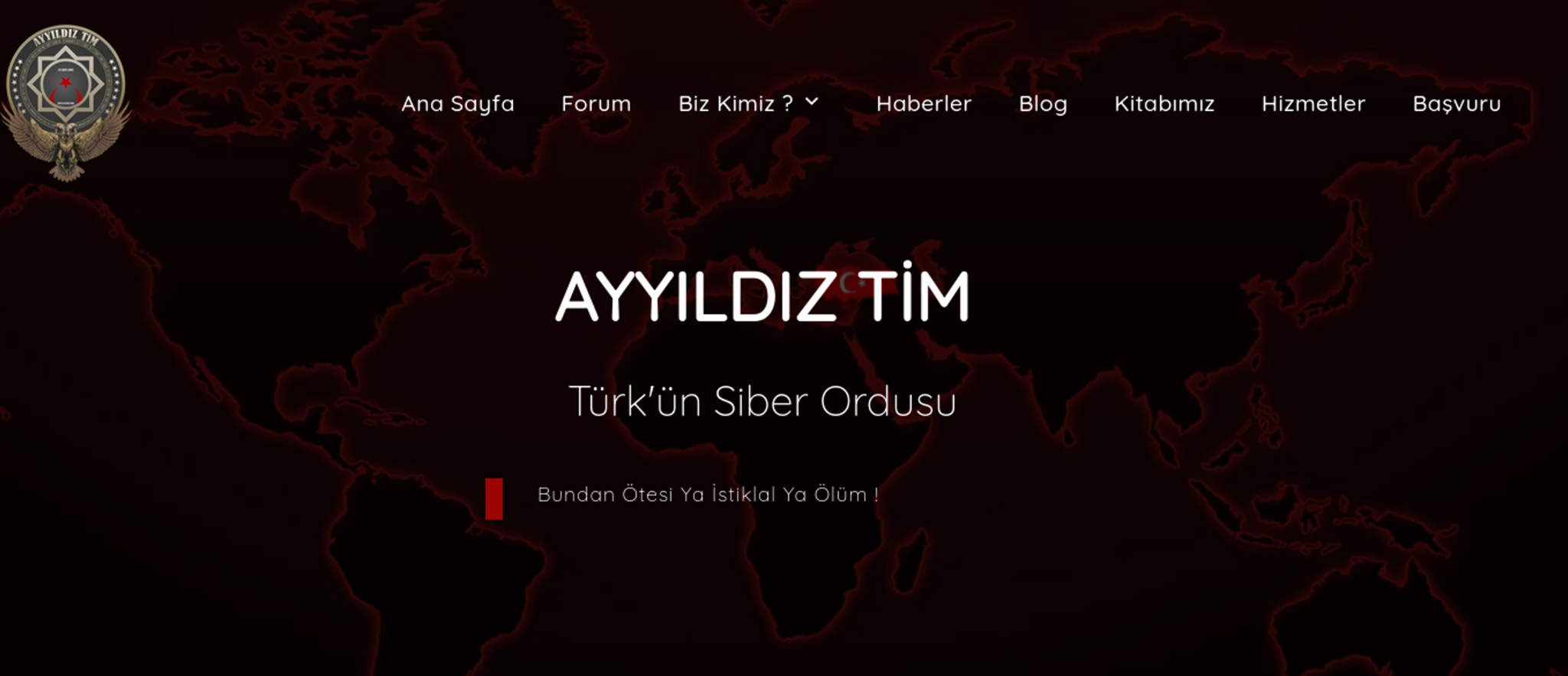
Figure 1: Ayyıldız Forum’s homepage proclaiming Ayyıldız Team to be “Turk’s Cyber Army”, with subheading “Beyond this it’s either freedom or death” (Source: Ayyıldız Forum)
Turkish-language hackers do not express concern for government action if they get caught breaching the infrastructure or websites of foreign organizations. Underground discussions indicate that members of the Turkish-language forums assume the Turkish government will show leniency toward their patriotic hacking activities as long as they are not directed at domestic entities. Occasionally, however, we have seen targeting of domestic entities and individuals who have expressed views in opposition to official state positions.
As detailed in our previous reporting on the Turkish dark web, common targets for patriotic hacking activity include websites from countries that are perceived to be “enemy” states due to historical conflicts, such as Greece and Armenia, as well as websites and services from countries such as Germany and France, which the Turkish government has had turbulent ties with due to contemporary political events.
We observed an increase in the number of Russian websites targeted by patriotic hacktivist groups in the last 10 months since the beginning of Russia’s invasion of Ukraine, including Anka Red Team allegedly compromising data from multiple Russian organizations on May 19, 2022. The organizations affected by the so-called “special operation” include the Ministry of Economy of Russia, the Federal Security Service of the Russian Federation, the Federal Council of the Russian Federation, the Federal Assembly of the Russian Federation, and Russian business professionals. The targeting of Russian entities reflects Turkey’s unique position in the Russo-Ukrainian conflict and its complex relationship with both countries. Despite Turkey’s military and political ties to Russia, Turkish defense firm Baykar has been a provider of Bayraktar drones to the Ukrainian military, with Ukrainian President Volodymyr Zelenskyy announcing on September 12, 2022 that Baykar is planning to build a factory in Ukraine. Turkey also hosted 4-way talks in Istanbul between officials from Turkey, Russia, Ukraine, and the United Nations (UN) to discuss the safe export of Ukrainian grain in July 2022. Likely as a result of Turkey’s official stance as a neutral country and the global support for the Ukrainian cause, Turkish patriotic hackers have ignored President Erdogan’s close ties with Russian President Vladimir Putin.
Anka Red Team
Figure 2: “Cyber coat of arms” for Anka Red Team (Source: Turk Hack Team Forum)
Anka Red Team, sometimes referred to as Turk Hack Team (THT), is a patriotic hacking threat group operating primarily out of the Turk Hack Team Forum. Similar to other Turkish-language patriotic hacking groups, Anka Red Team uses nationalistic imagery and rhetoric. Their hacktivist activity primarily includes defacement operations and occasional leaks of compromised data. Anka Red Team records their defacement operations on Zone H under the username “ZoRRoKiN”, and other defacement archives under the username “TurkHackTeam”. Anka Red Team uses the forum’s “Gövde Gösterisi” (“Show of Force”) section to announce new victims. Active members of Anka Red Team include “P4$A”, “OBT is HeRYerDe”, and “Safak-Bey”.
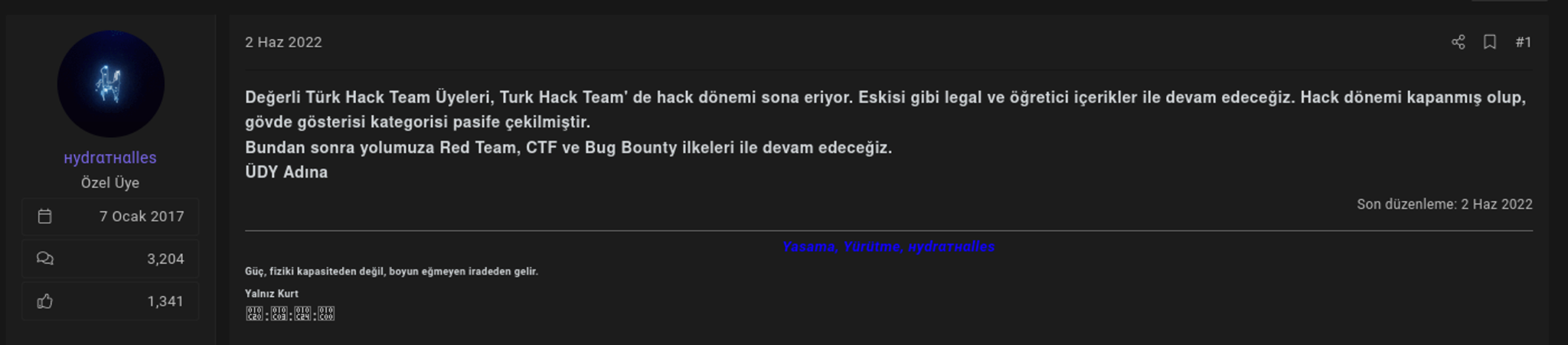
Figure 3: Turk Hack Team announces that they are stopping hacking and defacement activities (Source: Turk Hack Team Forum)
On June 2, 2022, “Hydrathalles”, a member of Turk Hack Team Forum, announced that Anka Red Team would not be engaging in any further “hacking” activities, including defacements, and that the Show of Force section of the forum would no longer be active. The user stated that Turk Hack Team Forum would continue to share “legal and educational” content. On October 15, 2022, “Bermuda”, an administrator of the forum, created a new thread where they proclaimed that Anka Red Team would recommence its hacking activities due to “the current situation”. While the threat actor did not specify what the current situation is, this phrase might refer to Turkey’s involvement in multiple geopolitical conflicts including the Russo-Ukrainian War and Turkey’s increased tensions with Greece. The threat actor explained that while it appeared that Anka Red Team was not active, they were working in the background to overcome “legal issues”, and that after installing stricter rules for the Show of Force section, the team could safely continue their operations. In the same thread, Bermuda emphasized the need for more sophisticated attack vectors including obtaining and leaking source codes and databases from victim websites, DDoS attacks, infecting devices with malware, and adding infected devices to the “THT Botnet Network”. The new rules for the Show of Force section state that team members who are able to maintain persistence via backdoors on infected devices will be added to a “special operations team”. Defacing or otherwise harming Turkish websites and carding activity is expressly prohibited by the administrators.
The period immediately before and after Hydrathalles’s statement that Anka Red Team would stop hacktivist operations was marked with a decrease in defacement activity by Anka Red Team (see Figure 4). Coinciding with Bermuda’s announcement, we observed a sharp spike in the number of defacement victims posted by Anka Red Team on Zone H, primarily relying on SQL injection attacks.
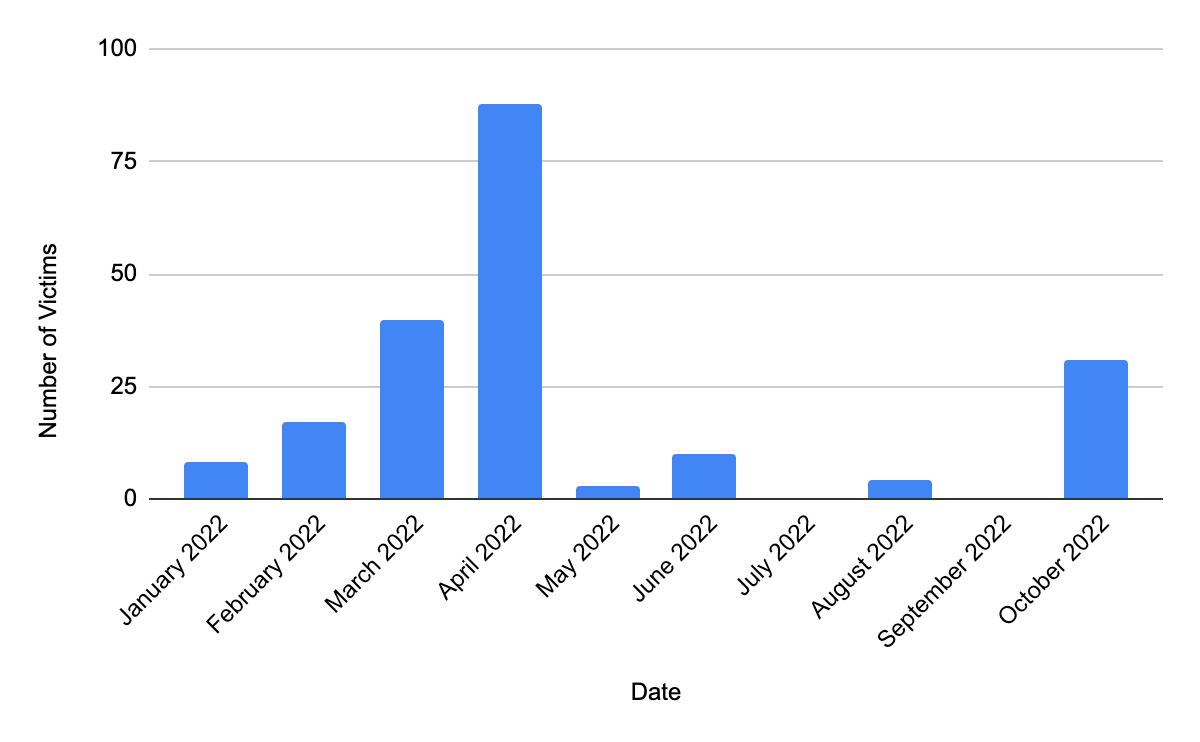
Figure 4: Overview of Anka Red Team’s defacement victims between January and October 2022 (Source: Zone H)
Ayyıldız Team
Figure 5: “Cyber coat of arms” for Ayyıldız Team (Source: Ayyıldız Forum)
Ayyıldız Team is a patriotic hacking threat group primarily operating out of Ayyıldız Team Forum. In addition to nationalistic imagery, Ayyıldız Team uses military terms to refer to its operations (such as “Offensive Teams” or “Special Operations”) and military ranks to organize its members. The threat group is primarily focused on defacement operations. Active members of Ayyıldız Team include “Orion-Pax”, “AYDOĞAN”, and “Toyonzade”.
Cybercrime and Fraud Trends
We find that the trend of Turkish-language threat actors targeting international entities more than domestic entities persists. All Turkish-language forums we investigated have forum rules that prohibit targeting Turkish entities or releasing documents that will negatively affect the Turkish government’s reputation or national interests. We did discover Turkish-speaking threat actors selling databases or initial access to Turkish organizations on popular, non-Turkish sources including the forums Exploit, XSS, and BreachForums.
Initial Access Sales to Turkish Organizations
Threat actors require remote access to compromised networks to conduct successful attacks such as data exfiltration attacks or espionage campaigns. Initial access brokers (IABs) are threat actors who specialize in selling compromised access methods on dark web and special-access forums. As detailed in our previous reporting, IABs are crucial elements in successful ransomware attacks. Top-tier forums XSS and Exploit are the primary sources where IABs advertise access methods and provide access to compromised corporate virtual private networks (VPNs), Citrix gateways, remote desktop protocol (RDP) services, corporate webmail servers, and content management systems (CMSs).
Most initial-access method advertisements do not mention the victim company or organization by name to avoid detection and attribution by law enforcement. Instead, threat actors provide details on the following parameters: “victim country”, “annual revenue”, “industry”, “type of access”, “rights”, “data to be exfiltrated”, and “devices on local network”.
According to our research, threat actors found to be selling initial access to entities in Turkey include the following 3 monikers on Exploit Forum: “zirochka”, “shear”, and “SubComandanteVPN”. These threat actors are prolific initial access sellers and target organizations across multiple geographies and industries. Appendix A of this report includes a detailed table (Table 2) of initial access sales from organizations in Turkey that we have observed in the last 6 months.
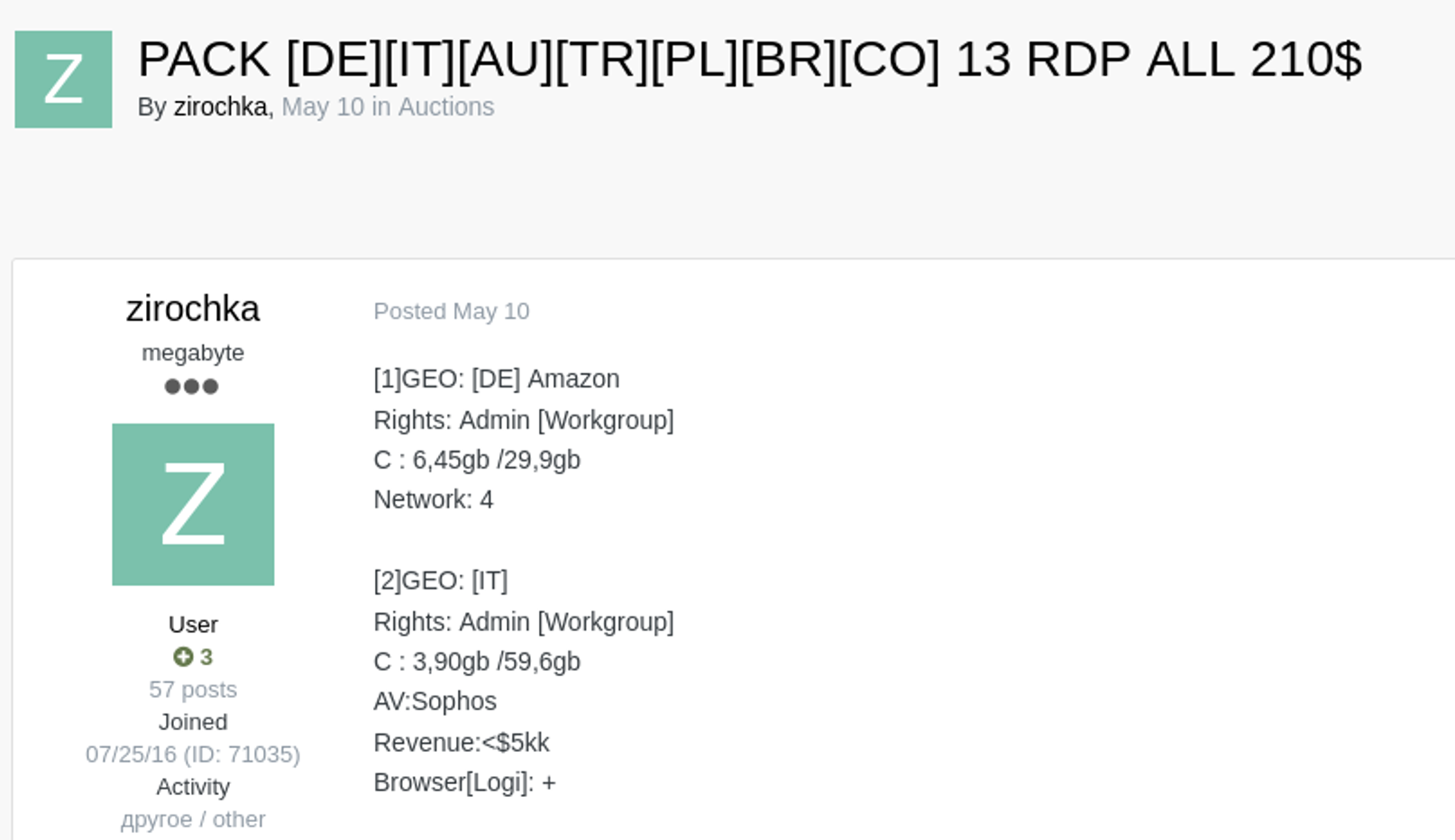
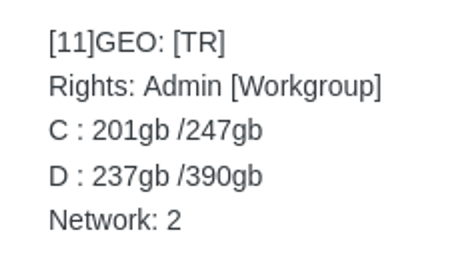
Figure 6: Threat actor zirochka advertising initial access to organizations in 13 countries, including an organization in Turkey (Source: Exploit Forum)
Compromised Data Sales
Threat actors are able to obtain confidential data from Turkish organizations and companies through a variety of attack vectors, including exploiting vulnerabilities in web applications to access data by means such as SQL injection, network intrusions, and phishing attacks. Data obtained via these attack vectors are shared or sold on dark web and special-access sources and can be used for fraud or other financially motivated attack vectors such as credential stuffing.
We found that threat actors targeting Turkish organizations did not advertise stolen data on Turkish-language forums. Instead, they shared or sold compromised Turkish data primarily on English- or Russian-language forums, thereby avoiding scrutiny from Turkish domestic law enforcement and reaching a larger audience. These dark web and special-access sources include top-tier forums XSS and Exploit, mid-tier BreachForums, and various public and private Telegram channels. Appendix B of this report includes a detailed table (Table 3) of compromised data sales from organizations in Turkey that we have observed in the last 6 months.
Opportunistic threat actors that frequently target Turkish entities include those who are active on the Telegram channel “數據洩露 | Leak Data | Data Leak Breach” and the associated Telegram user “MooT” (@MooTnew). Since June 2022, there have been approximately 20 listings shared in this Telegram group advertising compromised data from Turkish companies. While this is a significant number of victims from Turkey, the Telegram group shares dozens of other listings every week and members do not appear to be targeting particular geographies. As such, we do not believe the threat actor or group running the Telegram account is targeting Turkey in particular. However, we suggest monitoring the “Messaging Platforms — Cyber” source type for mentions of brands of interest in order to be notified of any victims shared on Telegram channels such as this one.
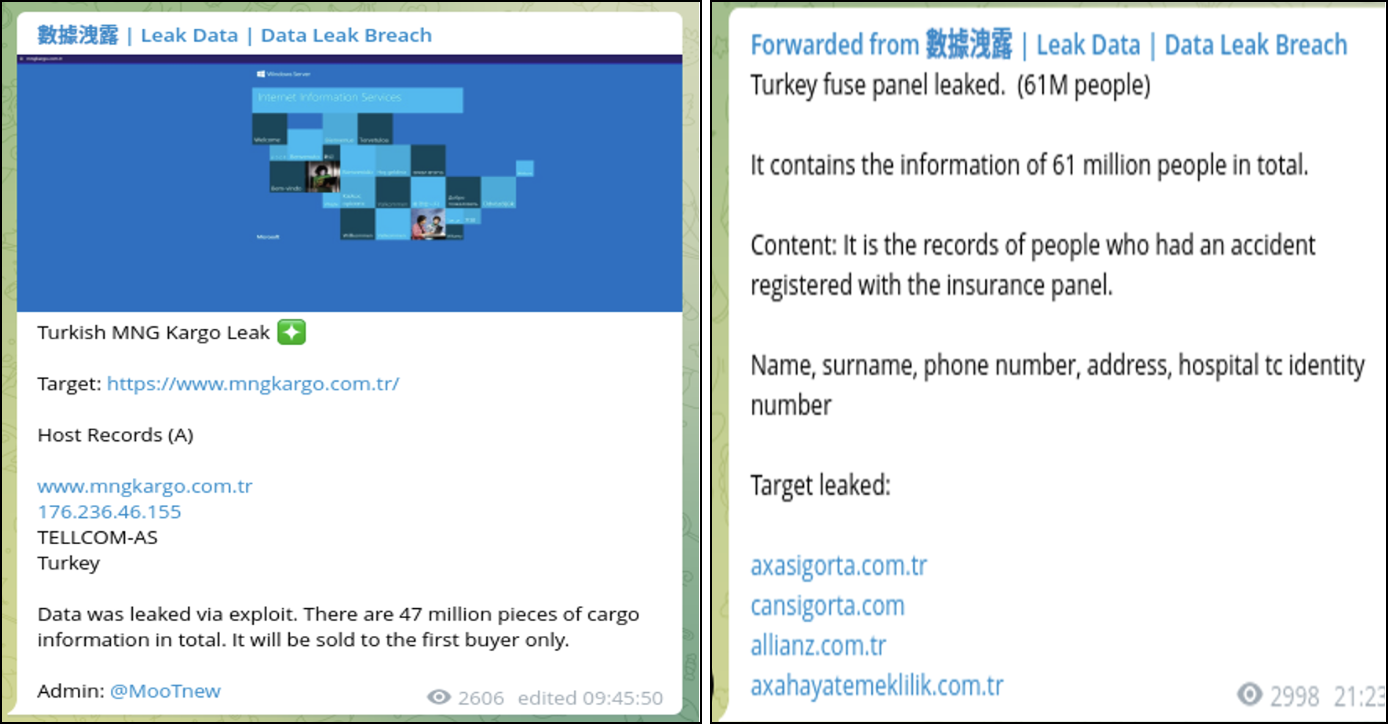
Figure 7: Compromised data from Turkish companies being advertised on the Telegram channel “data_leak_breach” (Source: 數據洩露 | Leak Data | Data Leak Breach)
Other threat actors that target Turkish organizations include “saderror” on BreachForums as well as “xssisownz” (also known as “Str0ng3r” on BreachForums), who is active on the forums BreachForums and XSS. The threat actor saderror has shared multiple databases from Turkish organizations including:
- A 17.3 GB database from Turkey’s Police Organization (Emniyet Genel Müdürlüğü)
- A database containing employee data from Vestel (vestel[.]com[.]tr), a home appliances manufacturer headquartered in Turkey
- A database from Eysis (eysis[.]io), a Turkish learning management website
- A log file from albumdunyasi[.]org, a Turkish website for sharing music
- Records of personal information for Turkish political leaders, including Turkey’s President Recep Tayyip Erdoğan, such as national identity numbers, physical addresses, and identity registration cities
The threat actor xssisownz was selling the following databases from Turkish organizations and websites on BreachForums and XSS:
- A 76,000-record database related to Risale-i Nur Forum (risaleforum[.]net), a Turkish-language religious and Islamic lifestyle forum, for $250
- A database for the Turkey-based fitness and wellness shop Bigjoy Sports (bigjoy[.]com[.]tr) for $100
- A 15 GB, 120 million-record database related to Sinoz Kozmetik (sinoz[.]com[.]tr), a Turkish cosmetics brand, for $500
Ransomware
According to open-source intelligence and Recorded Future’s ransomware victim data, Turkey is a prominent target for ransomware attacks. Sophos’s report, The State of Ransomware 2022, notes that approximately 60% of the survey respondents in Turkey were targeted by ransomware in the past year and that the average cost of rectifying the attack was $370,000 USD. According to CheckPoint, in 2020 Turkey was the 5th-most targeted country in ransomware attacks, behind Russia, Sri Lanka, India, and the US.
Recorded Future data shows that as of October 2022, 9 organizations from Turkey had their names published and/or data leaked on ransomware extortion websites in 2022 (Figure 8). LockBit Gang was the primary threat group responsible for attacks against Turkish organizations; however, ransomware attacks are opportunistic in nature and ransomware groups target victims primarily based on profitability. Therefore, we do not believe that any of these groups, including LockBit Gang, were targeting Turkish organizations in particular.
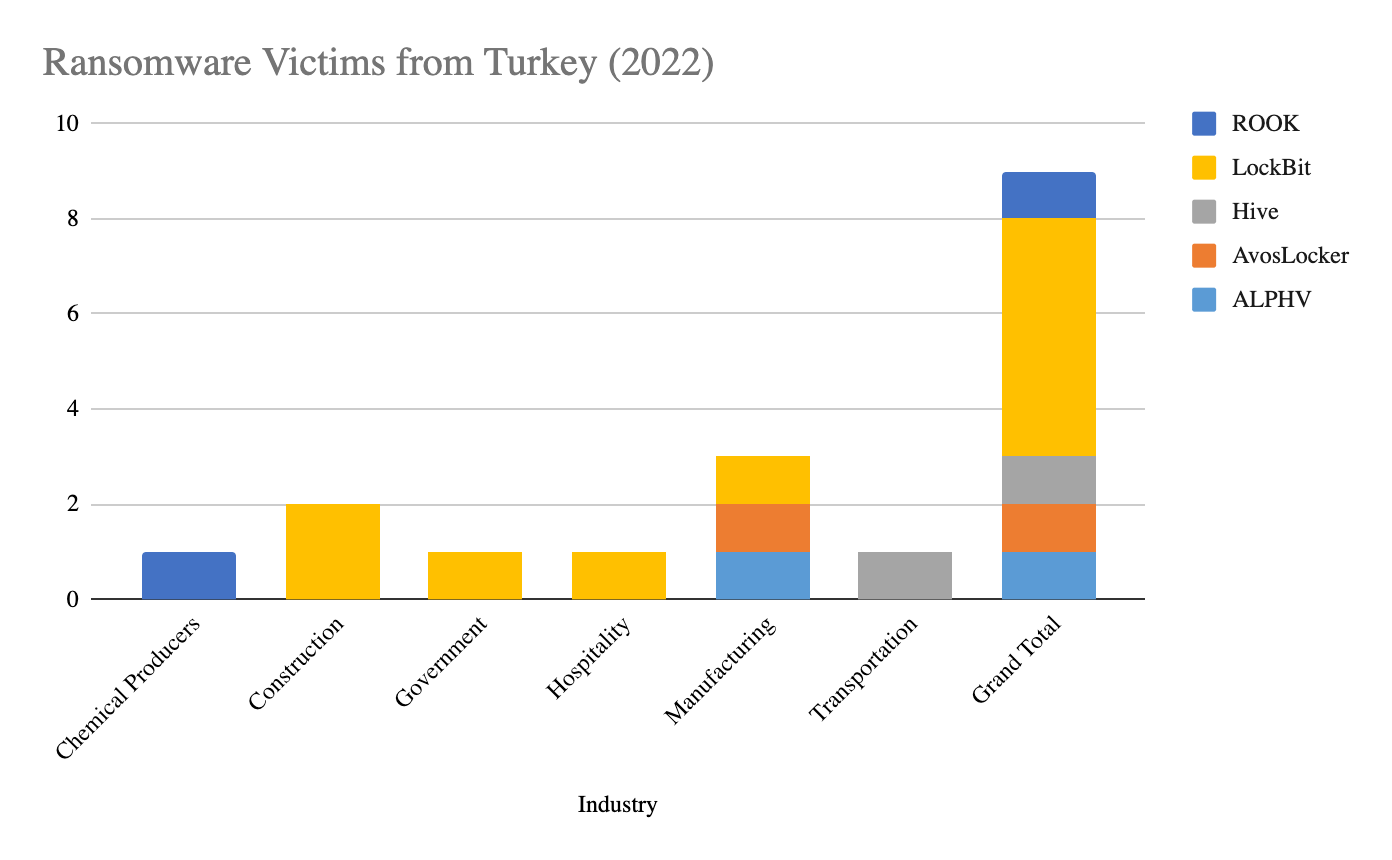
Figure 8: Overview of Turkish organizations whose data was leaked on ransomware extortion websites in 2022 (Source: Recorded Future)
We found multiple Turkish-language ransomware strains and threat groups as part of our research, including TurkStatik ransomware, SifreCikis ransomware, and DeadLocker ransomware. According to the ransom notes and infected files we found, these ransomware strains have infected victims in Turkey in the past 6 months; however, the victims were not listed publicly since these ransomware groups do not have ransomware extortion blogs.
TurkStatik Ransomware
TurkStatik ransomware was first referenced on November 22, 2019, when a security researcher, @malwareforme (Jack), reported about its capabilities to encrypt victims’ files, appending them with the “.ciphered” extension. TurkStatik is Turkey-specific ransomware designed to target Turkish-speaking victims. It encrypts victims’ files using the Rijndael 256 algorithm and drops a Turkish-language ransom note titled “README_DONT_DELETE.txt” onto the victim’s system. The ransom note states that all of the victim’s data has been encrypted and claims that the only way to recover the files is to pay the ransomware operators behind the infection. The ransomware operators include the email addresses decservice@mail[.]ru and recoverydbservice@protonmail[.]com as points of contact. Emsisoft created a decryption tool for TurkStatik ransomware.
SifreCikis Ransomware
SifreCikis is another ransomware that targets Turkish-language victims. First observed on November 10, 2020, it encrypts victim data by appending files with a random pattern extension. The Turkish-language ransom note instructs victims to contact the SifreCikis operators via the email nitas811@protonmail[.]com to pay a $500 ransom, and also references the currently defunct TOR website address sifrecikx7s62cjv[.]onion. SifreCikis ransomware was reportedly spread via spam campaigns and malware infections.
DeadLocker Ransomware
As reported by MalwareHunterTeam on April 21, 2022, DeadLocker is a ransomware that encrypts victims’ files by appending the file extension type to “.deadlocked”. The malware prompts the victim device to display a pop-up that contains the ransom note, written in Turkish, which instructs the victim to contact a Discord account (ParadoX#8495) to obtain payment details (Figure 9). The requested ransom amount varies from $300 to $650 in Discord Nitro, which is the credit system used in the Discord application to purchase a premium membership or other add-ons. It is important to note that “BattleLocker” ransom notes with the same visual style and formatting have also been discovered. This indicates that DeadLocker and BattleLocker are different names given to the same off-the-shelf ransomware strain used by less technically proficient actors. Additionally, the fact that the primary method of communication is a Discord account and the payment is requested in Discord currency indicates that the threat actors operating the malware are likely less sophisticated and young individuals focused on improving their financial status within the Discord application.
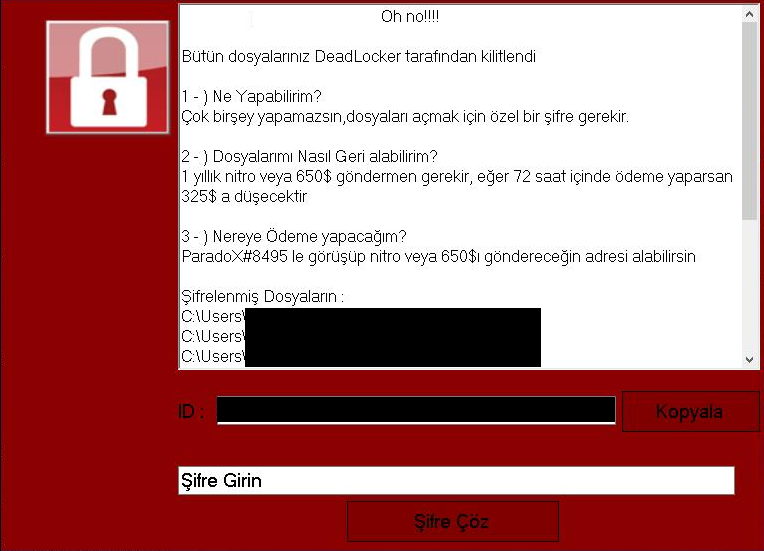
Figure 9: A ransom note written in Turkish from “DeadLocker” ransomware (Source: MalwareHunterTeam)
In addition to the ransomware strains mentioned above, we discovered a victim page from an unnamed ransomware group with a ransom note (Table 1) written in Turkish. The ransom note instructs the victim to log on to a victim payment dashboard (Figure 10) using a custom identification number. The payment dashboard contains payment details including the recipient’s Bitcoin (BTC) address and guidance on how to obtain cryptocurrency in Turkey. The ransom price is $250 USD. The language proficiency and Turkey-specific URLs embedded in both the ransom note and the payment dashboard indicate that the operators of the ransomware are native Turkish speakers.
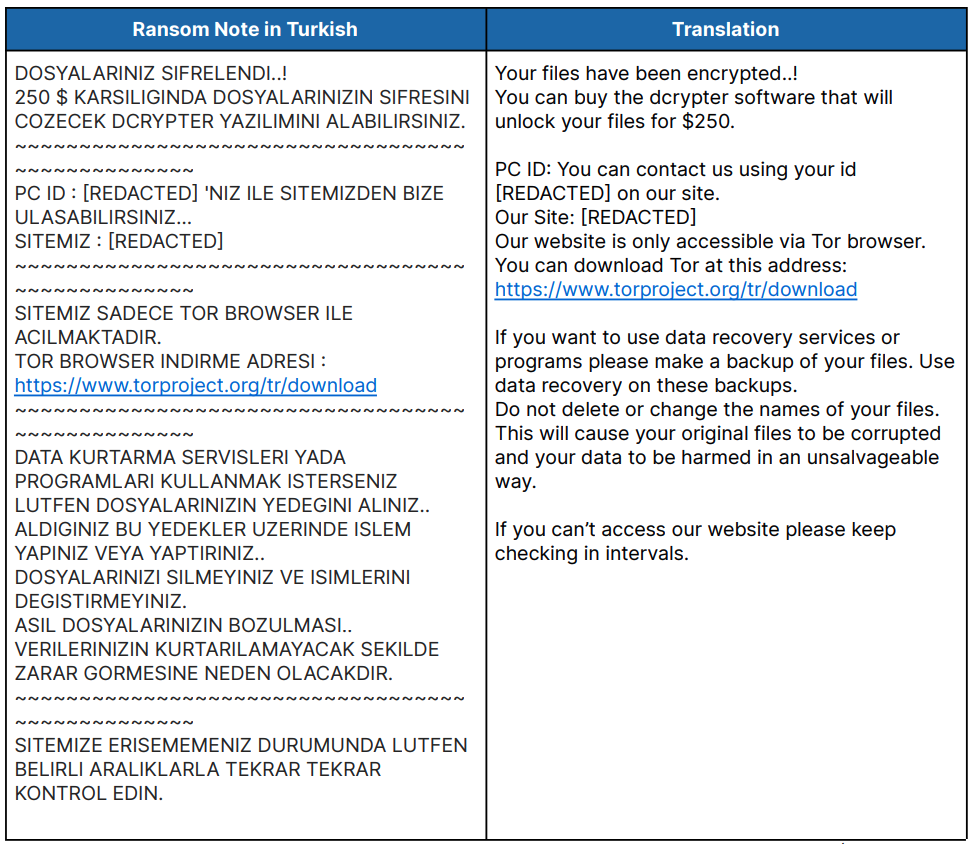
Table 1: Turkish ransom note left on victim’s device after it was infected by an unidentified encrypter malware (Source: Recorded Future)
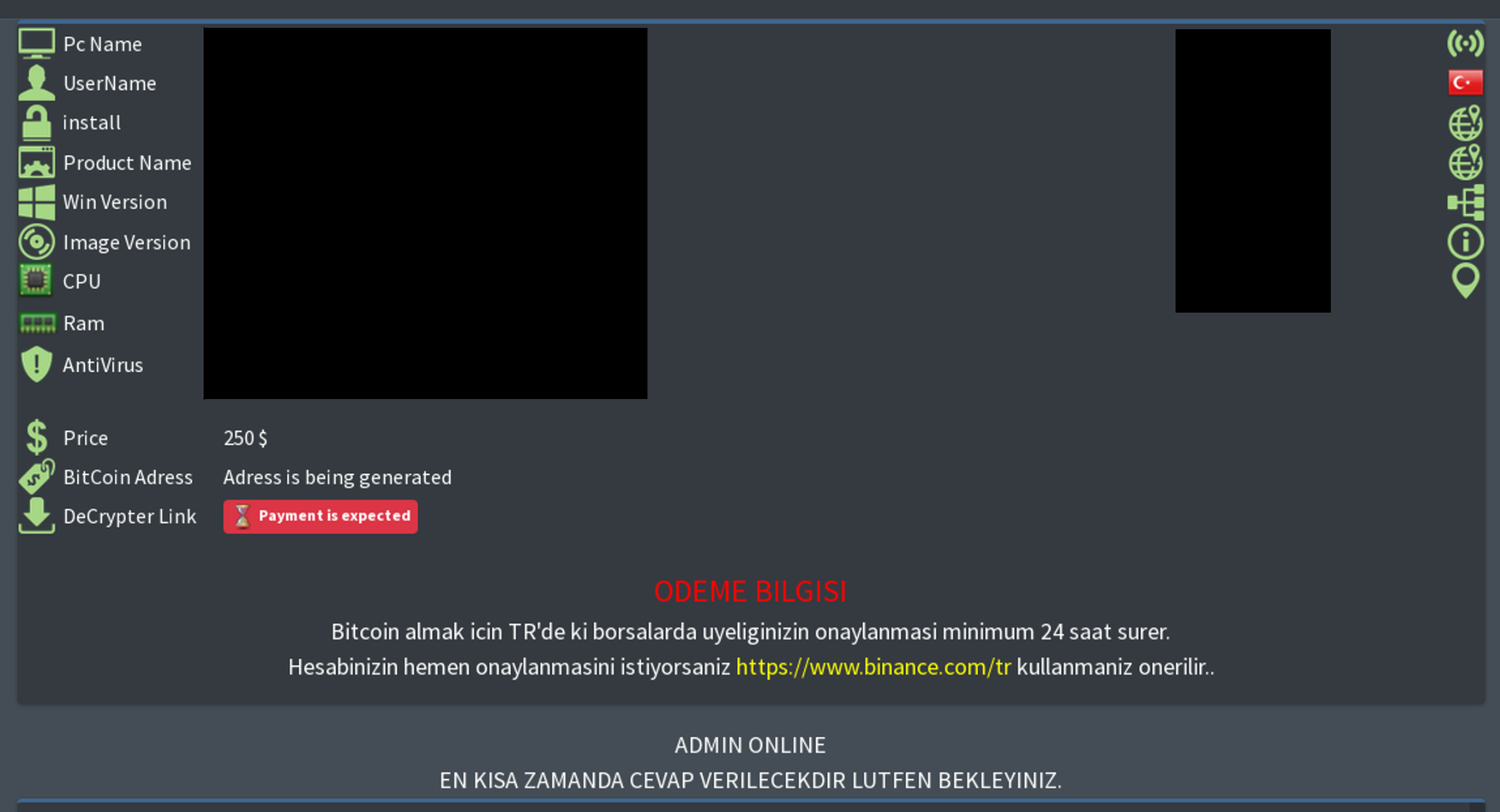
Figure 10: The victim dashboard from an unidentified Turkish-language encrypter malware or ransomware (Source: Recorded Future)
Outlook
We expect patriotic hacking groups to continue to target state and private entities whose political agenda diverges from the official Turkish state course. These threat actors will continue to deface websites, breach servers, and steal or leak databases of countries that oppose the Turkish state in the international arena. We will continue to monitor patriotic hacking communities for any escalations in attack vectors.
Ransomware-as-a-service (RaaS) models decrease the barriers for entry to the lucrative ransomware space, which is likely an alluring prospect for unemployed or low-earning Turkish nationals looking to engage in cybercriminal activity. As such, there will likely be an increase in Turkish-language ransomware groups of varying technical sophistication, from young gamers looking to earn pocket change to more operationally secure ransomware operators targeting small to medium-sized businesses. We recommend that organizations take necessary mitigation measures against ransomware attacks including implementing YARA rules to identify malware via signature-based detection.
Sources for this report include the Recorded Future Platform and open-web and dark web research.
Appendix A: Initial Access Sales
| Threat Actor | Intelligence |
|---|---|
| "sganarelle2" | On October 13, 2022, sganarelle2, a member of the top-tier forum Exploit, was auctioning Kerio Control access with administrator privileges to an unspecified Turkish company with over $50 million in annual revenue and 250 employees. The starting price is $300 or it can be purchased immediately for $2,000. The credibility of sganarelle2 is high. |
| "K_E_N_Z_O" | On September 11, 2022, K_E_N_Z_O, a member of the top-tier forum Exploit, was auctioning access with local administrator privileges to the network of an unspecified Turkish travel agency headquartered in Istanbul with $18 million in annual revenue. OSINT indicates the victim is likely Vista Tourism & Travel A.S. (vistatourism[.]com). The starting price is $800 or it can be purchased immediately for $1,500. The credibility of K_E_N_Z_O is low. |
| "shear" | On August 30, 2022, shear, a member of the top-tier forum Exploit, was auctioning access to an unnamed Turkish online retailer that sells automotive parts. The starting price is $100 or it can be purchased immediately for $500. The credibility of shear is high. |
| "19cm" | On August 19, 2022, 19cm, a member of the top-tier forum Exploit, was auctioning RDP access with workgroup administrator privileges to the network of 4 international organizations, one of which is headquartered in Turkey: an unspecified Turkish company with $5 million in annual revenue. The starting price is $600 or all 4 networks can be purchased immediately for $1,000. The credibility of 19cm is low. |
| "zirochka" | On August 11, 2022, zirochka, a member of the top-tier forum Exploit, was selling RDP access with local administrator and domain user privileges to the network of an unspecified luxury beach hotel in Turkey with $5 million in annual revenue. The starting price was $50 or it could be purchased immediately for $70. The credibility of zirochka is high. |
| "orangecake" | On June 18, 2022, orangecake, a member of the top-tier forum Exploit, was selling shell access to multiple networks including a company in Turkey with $84 million in annual revenue that specializes in business service. The threat actor requested $800. The credibility of orangecake is high. |
| "zirochka" | On May 13, 2022, zirochka was auctioning RDP access to 13 entities for $210, one of which is a Turkish organization with Amazon Athena Workgroup access to approximately 450 GB of data and 2 devices on its local network. The credibility of zirochka is high. |
| "Nei" | On May 12, 2022, Nei, a member of the top-tier forum Exploit, was auctioning VPN and RDP access with administrator privileges to an unnamed Turkish chemical company with approximately $20 million in annual revenue. The starting price is $600 or it can be purchased immediately for $1,200. The credibility of Nei is high. |
| "shelltrades" | On May 3, 2022, shelltrades, a member of the top-tier forum Exploit, was auctioning access to an unspecified Turkish online retailer that processes approximately 13 transactions per day and has 9,000 lifetime orders. The starting price is $1,200 or it can be purchased immediately for $1,600. The credibility of shelltrades is unknown. |
| "nopiro" | On April 28, 2022, nopiro, a member of the top-tier forum Exploit, was selling unspecified access with domain administrator privileges to the networks of a Turkish company that specializes in steel and energy distribution as well as logistics services with approximately $4 billion in annual revenue. The threat actor compromised approximately 15,000 hosts. The credibility of nopiro is low. |
| "wiseguy01" | On April 24, 2022, wiseguy01, a member of the top-tier forum XSS, was selling VPN access to the network of an unspecified Turkish university for $2,000. The compromised network contains 2,046 devices. The credibility of wiseguy01 is low. |
| "69.pdf" | On April 7, 2022, 69.pdf, a member of the top-tier forum Exploit, was auctioning RDP access with domain administrator privileges to a Turkish biotechnology and pharmaceutical company with more than $1 billion in annual revenue. The starting price was $15,000 or it could be purchased immediately for $25,000. The credibility of 69.pdf is low. |
| "Neophyte" | On March 21, 2022, Neophyte, a member of the top-tier forum Exploit, was auctioning PulseSecure VPN access to an unnamed Turkish furniture accessories manufacturing company with $217 million in annual revenue and 800 employees. OSINT indicates the victim is likely Samet S.R.L (samet.com[.]tr). The starting price is $1,000 or it can be purchased immediately for $2,000. The credibility of Neophyte is low. |
| "shear" | On March 8, 2022, shear, a member of the top-tier forum Exploit, was auctioning domain access to the website of a highly-rated Turkish mobile application that allows users to send and receive money. The starting price is $100. As of this writing, there has been at least 1 bid on the auction, raising the price to $150. |
Table 2: An overview of initial access brokers’ advertisements targeting organizations in Turkey in the last 6 months (Source: Recorded Future)
Appendix B: Compromised Data Sales
| Threat Actor | Intelligence |
|---|---|
| "saderror" | On October 19, 2022, saderror, a member of mid-tier BreachForums, was sharing a database from Vestel (vestel[.]com[.]tr), a home appliances manufacturer headquartered in Turkey. The database contains approximately 10,000 records including employee names, phone numbers, job titles, and location data. The credibility of saderror is moderate. |
| "Paulsan" | On October 7, 2022, Paulsan, a member of mid-tier BreachForums, was sharing a database from Netas (netas[.]com[.]tr), a telecommunications technology company. The database contains employee names, phone numbers, ID numbers, and names of Netas clients. The data was obtained from BianLian Ransomware Group's extortion website. The credibility of Paulsan is low. |
| "xainn" | On September 16, 2022, xainn, a member of mid-tier BreachForums, was selling a 126 million-line database containing data related to Turkish citizens and their family members, including full names, places of birth, dates of birth, marital statuses, and other PII. The threat actor claims to be in possession of 452 GB of documents in JSON format. The credibility of xainn is low. |
| "data_leak_breach" | On August 31, 2022, a database from Yildiz Entegre (yildizentegre[.]com), a flooring manufacturer, was shared on the Telegram channel data_leak_breach. The credibility of the Telegram group is moderate, with more than 6,000 subscribers. |
| "MooTnew" | On August 22, 2022, a database containing customer data from MNG Kargo (mngkargo[.]com.tr), a shipping company, was shared on Telegram. The data was leaked via exploiting a vulnerability and contains information on 47 million pieces of cargo. The data was sold to a single buyer. The credibility of MooTnew is moderate. |
| "MooTnew" | On August 11, 2022, a database containing customer data from multiple Turkish insurance companies was shared on Telegram. The database contains records for 61 million people who had an accident and were registered with one of the affected insurance companies: Axa Sigorta, Can Sigorta, Allianz, and Axa Hayat Emeklilik. The credibility of MooTnew is moderate. |
| "0x_dump" | On July 4, 2022, a database from Tuttur (tuttur[.]com), a Turkish gambling website, was shared on Telegram. The file has 500,000 rows and includes customer data including names and phone numbers. The credibility of the Telegram group is moderate. |
| "Str0ng3r" (xssisownz) | On May 3, 2022, Str0ng3r, a member of mid-tier BreachForums, was selling a 76,000-record database related to Risale-i Nur Forum (risaleforum[.]net) for $250. The database includes emails and MD5-hashed passwords. The credibility of Str0ng3r is moderate. |
| "GokhanR00T" | On May 2, 2022, GokhanR00T, a member of mid-tier BreachForums, was sharing a database with 9 million records from Avea and Turk Telekom (turktelekom[.]com[.]tr), including users' Turkish identity numbers and phone numbers. The credibility of GokhanR00T is low. |
| "xssisownz" | On April 18, 2022, xssisownz, a member of the top-tier forum XSS, was selling a database for Bigjoy Sports (bigjoy[.]com[.]tr), containing data from over 55,000 customers, for $100. The credibility of xssisownz is moderate. |
| "ZouZic" | On July 25, 2022, ZouZic, a member of the top-tier forum Exploit, was leaking a 2020 database related to Fenerium (fenerium[.]com), the online shop of Fenerbahçe S.K. The credibility of ZouZic is high. |
| "lyoxa" | On August 14, 2022, lyoxa, a member of the top-tier forum Exploit, was auctioning approximately 2,700 valid payment cards affecting residents of Turkey. The bundle is approximately 70-80% valid and was harvested from a compromised online retailer. The starting price is $13,500 or it can be purchased immediately for $20,000. The credibility of lyoxa is high. |
| "copy" | On May 1, 2022, copy, a member of BreachForums, was selling a 63,000-record database related to Tofisa (tofisa[.]com), a Turkish online retailer of Islamic women's clothing, for 8 BreachForums credits. Compromised information includes UIDs, email addresses, passwords, and shipping addresses. The credibility of copy is high. |
| "xssisownz" | On March 10, 2022, xssisownz, a member of the top-tier forum XSS, was selling a 15 GB, 120 million-record database related to Sinoz Kozmetik (sinoz[.]com[.]tr) for $500. Of the 120 million records, 260,644 contain PII and plaintext passwords. The credibility of xssisownz is low. |
Table 3: An overview of threat actors selling compromised databases from organizations in Turkey in the last 6 months (Source: Recorded Future)
This report is also available as a PDF.